







Question: Consider a household with lifetime utility = - s=t where y, the Greek letter gamma, is a parameter greater than zero and , the
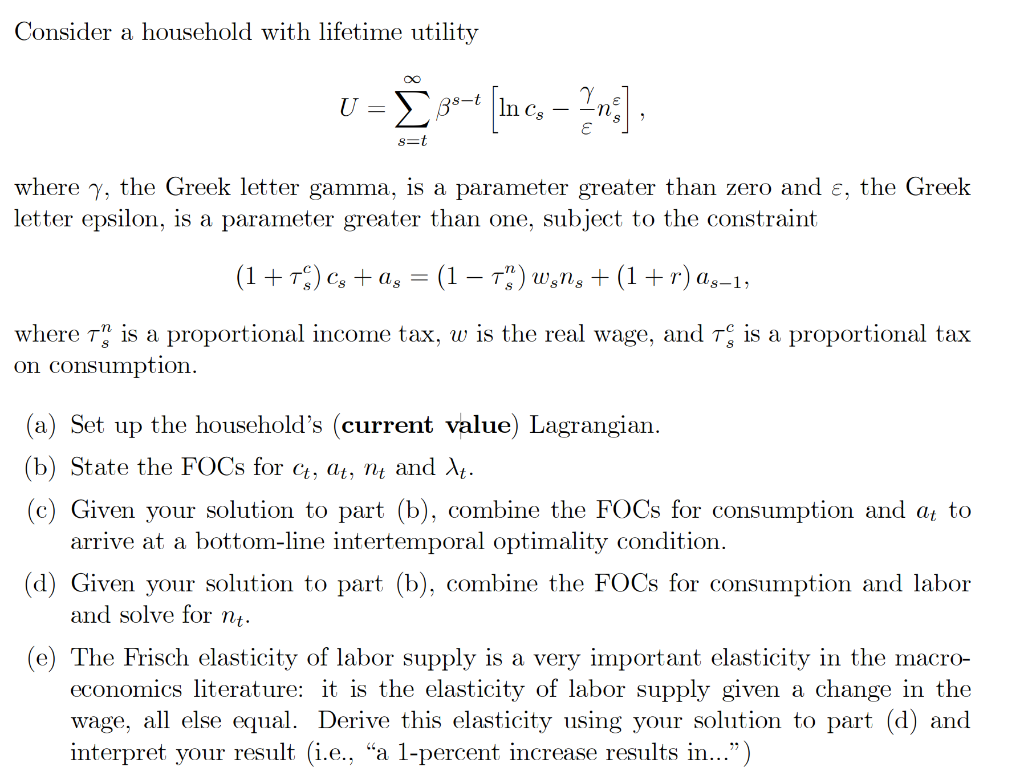
Consider a household with lifetime utility = - s=t where y, the Greek letter gamma, is a parameter greater than zero and , the Greek letter epsilon, is a parameter greater than one, subject to the constraint (1 + Tc) Cs + as = (1 T^) wn + (1 + r) as1, where 7 is a proportional income tax, w is the real wage, and 7 is a proportional tax on consumption. (a) Set up the household's (current value) Lagrangian. (b) State the FOCs for Ct, at, nt and t. (c) Given your solution to part (b), combine the FOCs for consumption and at to arrive at a bottom-line intertemporal optimality condition. (d) Given your solution to part (b), combine the FOCs for consumption and labor and solve for nt. (e) The Frisch elasticity of labor supply is a very important elasticity in the macro- economics literature: it is the elasticity of labor supply given a change in the wage, all else equal. Derive this elasticity using your solution to part (d) and interpret your result (i.e., "a 1-percent increase results in...")
Step by Step Solution
There are 3 Steps involved in it

Get step-by-step solutions from verified subject matter experts
 Study Help