







Question: Consider a laminar flow past an arbitrarily shaped surface for which the distribution of wall shear stress To(x) is known. The thermal boundary condition
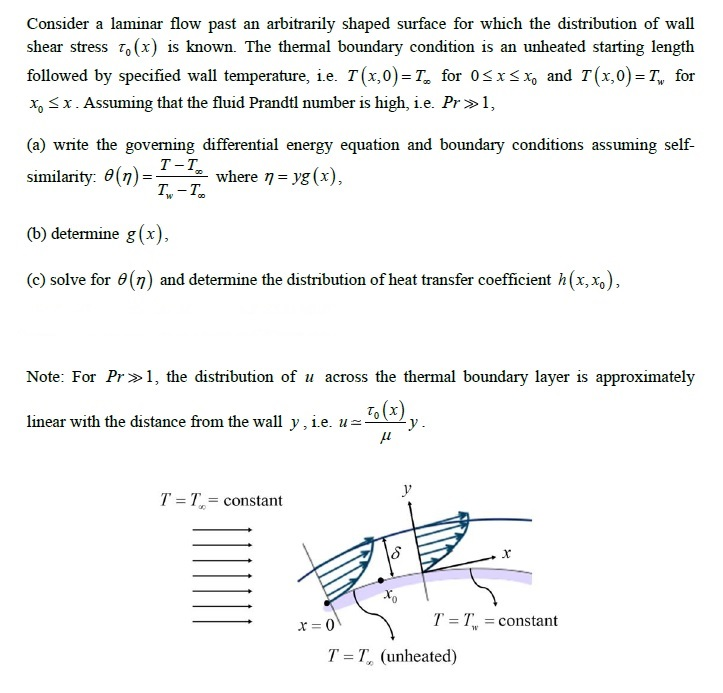
Consider a laminar flow past an arbitrarily shaped surface for which the distribution of wall shear stress To(x) is known. The thermal boundary condition is an unheated starting length followed by specified wall temperature, i.e. T(x,0)= T for 0xx, and T(x,0) = T, for x x. Assuming that the fluid Prandtl number is high, i.e. Pr1, (a) write the governing differential energy equation and boundary conditions assuming self- similarity: 0(n) = T-T Tw-Too where n = yg (x), (b) determine g(x), (c) solve for (n) and determine the distribution of heat transfer coefficient h(x,x), Note: For Pr>>>1, the distribution of u across the thermal boundary layer is approximately linear with the distance from the wall y, i.e. u= y. To (x) l T=T= constant x=0\ T = Tw TT (unheated) X = constant
Step by Step Solution
3.42 Rating (152 Votes )
There are 3 Steps involved in it
To address the given problem we will follow the steps provided a Governing Differential Energy Equation and Boundary Conditions For high Prandtl numbe... View full answer

Get step-by-step solutions from verified subject matter experts
 Study Help