







Question: Consider a linked list constructed using a Node class as we have used in class, with fields item and next. Assume that first is accessible
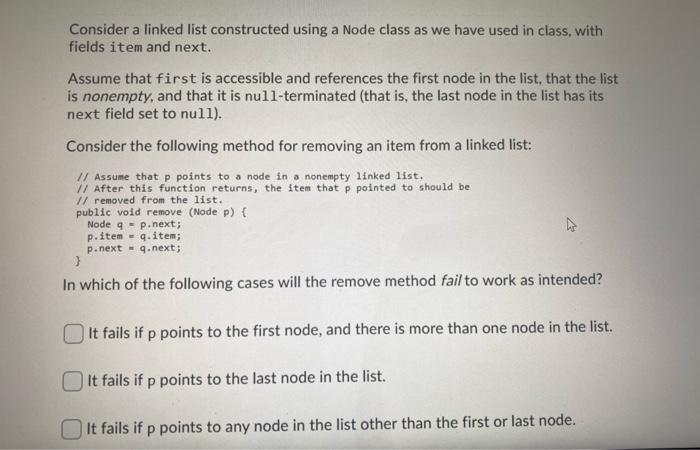
Consider a linked list constructed using a Node class as we have used in class, with fields item and next. Assume that first is accessible and references the first node in the list that the list is nonempty, and that it is null-terminated (that is, the last node in the list has its next field set to null). Consider the following method for removing an item from a linked list: // Assume that p points to a node in a nonempty linked list. / After this function returns, the item that p pointed to should be // removed from the list. public void remove (Node p) { Node 9 - p.next; p.item - q.item; p.next - 9.next; ) In which of the following cases will the remove method fail to work as intended? It fails if p points to the first node, and there is more than one node in the list. It fails if p points to the last node in the list. It fails if p points to any node in the list other than the first or last node
Step by Step Solution
There are 3 Steps involved in it

Get step-by-step solutions from verified subject matter experts
 Study Help