







Question: Consider a market with only two producers, each with constant marginal cost: MC1 = 20, MCz = 50. Market demand is Q = 400 -
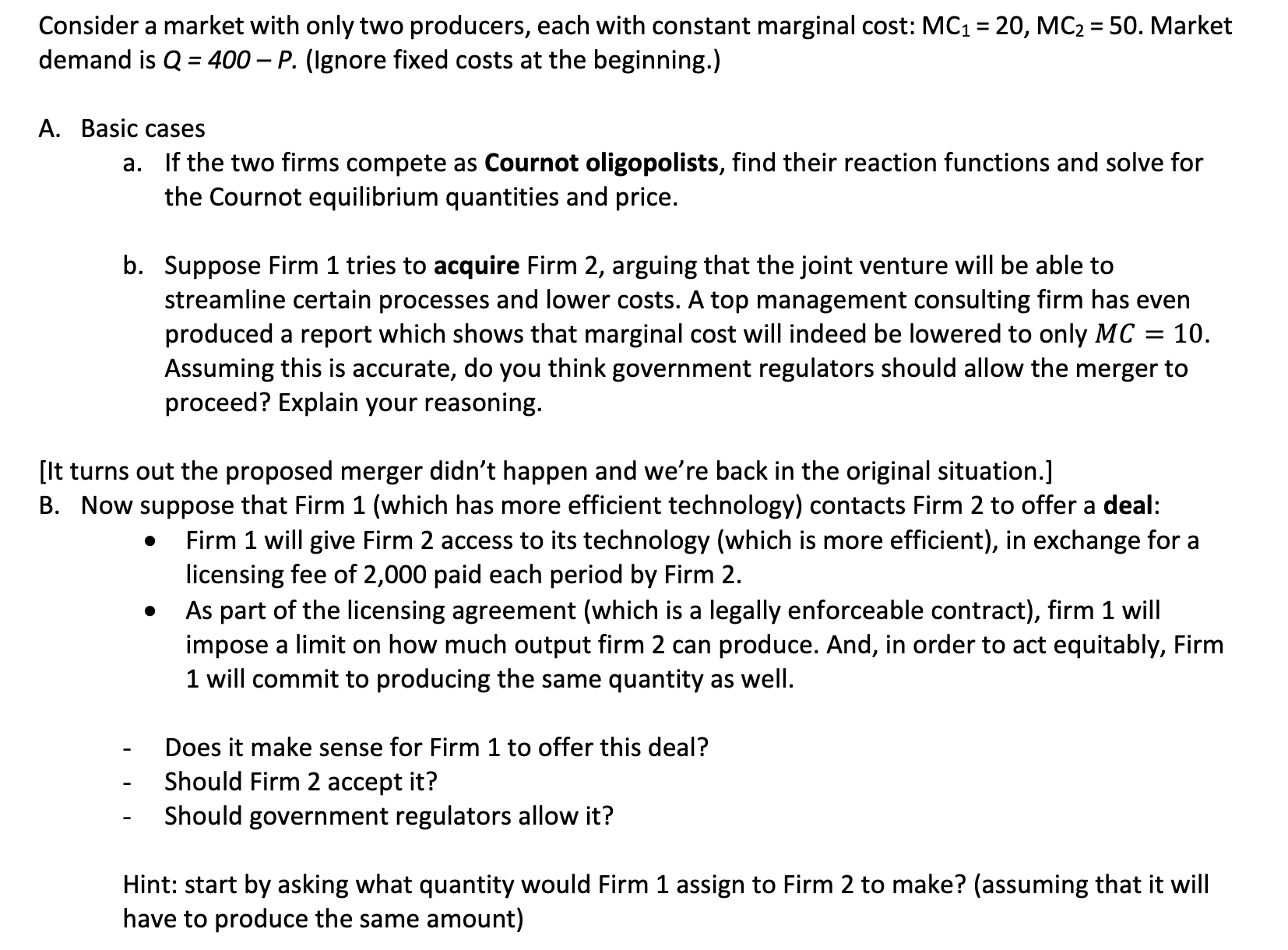
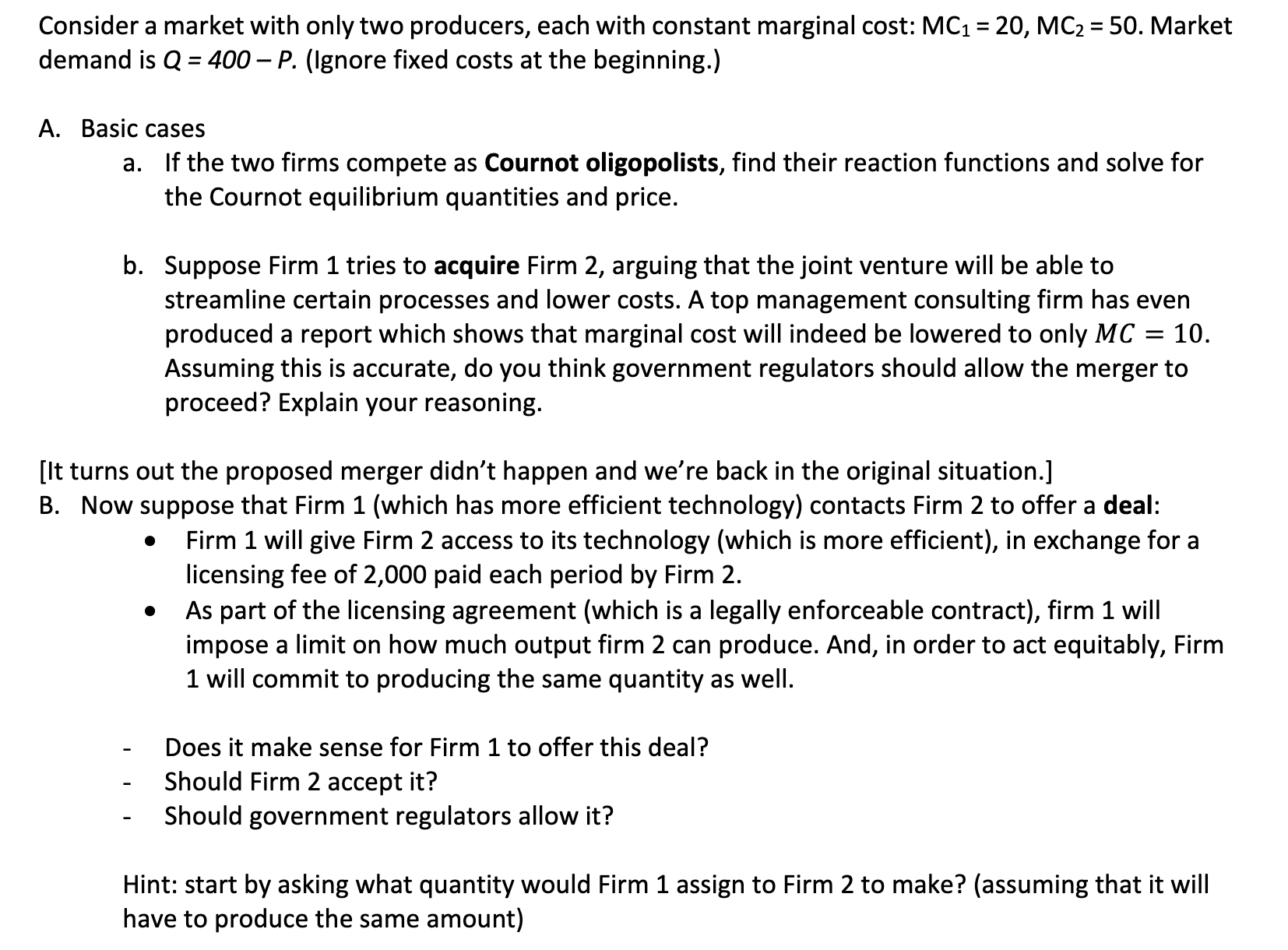
Consider a market with only two producers, each with constant marginal cost: MC1 = 20, MCz = 50. Market demand is Q = 400 - P. (Ignore fixed costs at the beginning.) A. Basic cases a. If the two firms compete as Cournot oligopolists, find their reaction functions and solve for the Cournot equilibrium quantities and price. b. Suppose Firm 1 tries to acquire Firm 2, arguing that the joint venture will be able to streamline certain processes and lower costs. A top management consulting firm has even produced a report which shows that marginal cost will indeed be lowered to only MC = 10. Assuming this is accurate, do you think government regulators should allow the merger to proceed? Explain your reasoning. [It turns out the proposed merger didn't happen and we're back in the original situation.] B. Now suppose that Firm 1 (which has more efficient technology) contacts Firm 2 to offer a deal: 0 Firm 1 will give Firm 2 access to its technology (which is more efficient), in exchange for a licensing fee of 2,000 paid each period by Firm 2. c As part of the licensing agreement (which is a legally enforceable contract), firm 1 will impose a limit on how much output firm 2 can produce. And, in orderto act equitably, Firm 1 will commit to producing the same quantity as well. - Does it make sense for Firm 1 to offer this deal? - Should Firm 2 accept it? - Should government regulators allow it? Hint: start by asking what quantity would Firm 1 assign to Firm 2 to make? (assuming that it will have to produce the same amount)
Step by Step Solution
There are 3 Steps involved in it

Get step-by-step solutions from verified subject matter experts
 Study Help