







Question: Consider a model where two parties compete for votes by offering different policy platforms. Assume that all parties commit to implementing the policy they
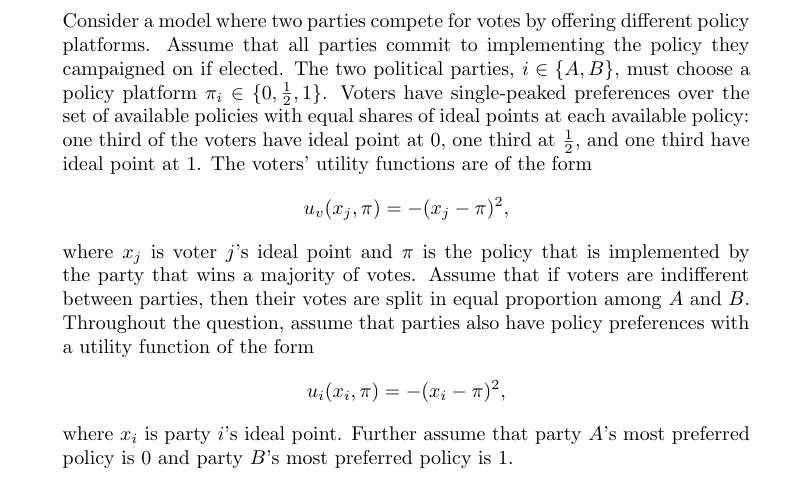
Consider a model where two parties compete for votes by offering different policy platforms. Assume that all parties commit to implementing the policy they campaigned on if elected. The two political parties, i {A, B}, must choose a policy platform = {0,1,1}. Voters have single-peaked preferences over the set of available policies with equal shares of ideal points at each available policy: one third of the voters have ideal point at 0, one third at , and one third have ideal point at 1. The voters' utility functions are of the form Uv (xj, ) = (x; ), - where xj is voter j's ideal point and 7 is the policy that is implemented by the party that wins a majority of votes. Assume that if voters are indifferent between parties, then their votes are split in equal proportion among A and B. Throughout the question, assume that parties also have policy preferences with a utility function of the form Ui (xi, ) = (xi ), - where x is party i's ideal point. Further assume that party A's most preferred policy is 0 and party B's most preferred policy is 1.
Step by Step Solution
There are 3 Steps involved in it

Get step-by-step solutions from verified subject matter experts
 Study Help