







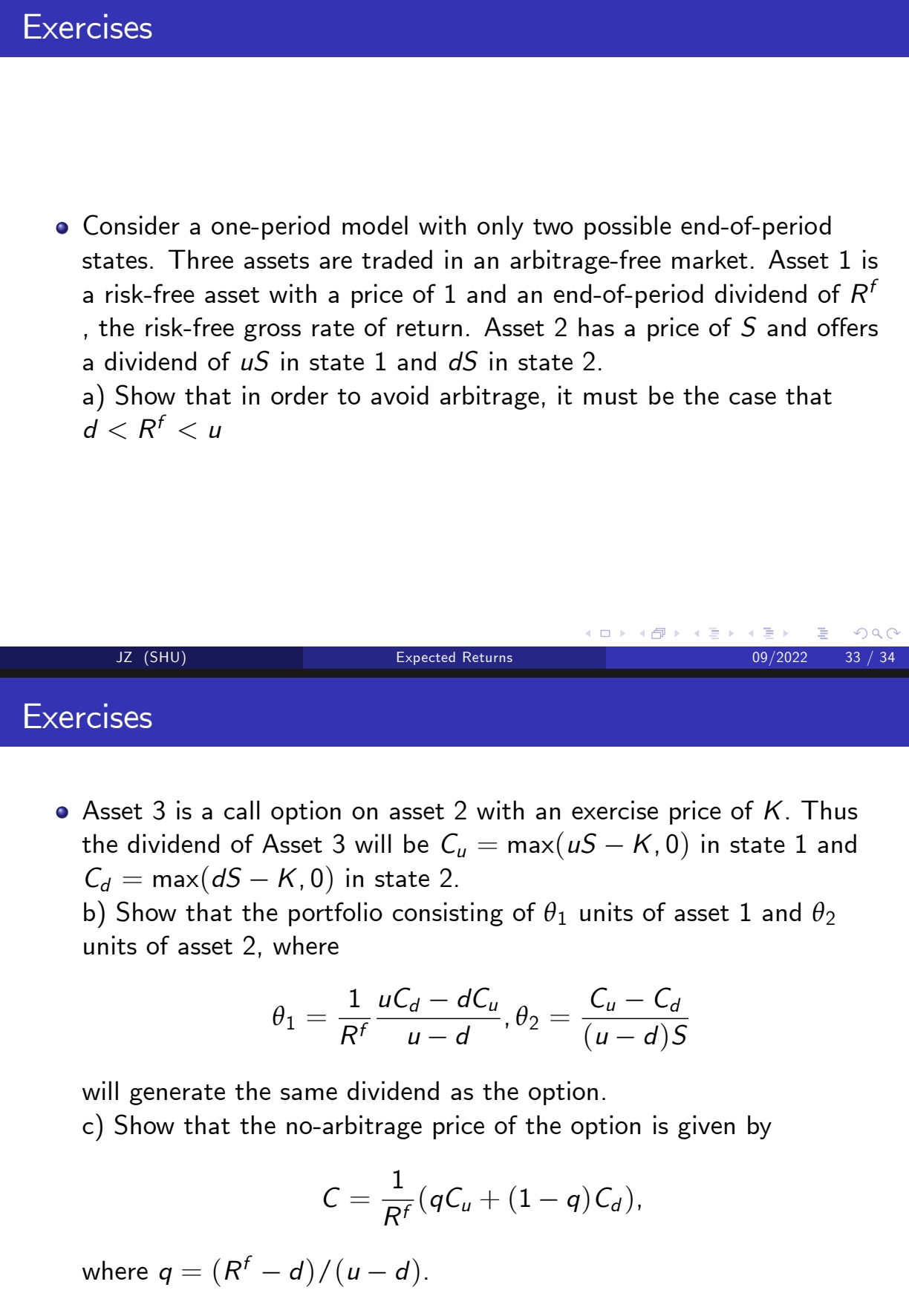
Question: Consider a one - period model with only two possible end - of - period states. Three assets are traded in an arbitrage - free
Consider a oneperiod model with only two possible endofperiod
states. Three assets are traded in an arbitragefree market. Asset is
a riskfree asset with a price of and an endofperiod dividend of
the riskfree gross rate of return. Asset has a price of and offers
a dividend of in state and in state
a Show that in order to avoid arbitrage, it must be the case that
maxmax
Exercises
Asset a call option asset with exercise price Thus
the dividend Asset will max state and
max state
Step by Step Solution
There are 3 Steps involved in it
1 Expert Approved Answer
Step: 1 Unlock

Question Has Been Solved by an Expert!
Get step-by-step solutions from verified subject matter experts
Step: 2 Unlock
Step: 3 Unlock
 Study Help