







Question: .. Consider a parallel plate capacitor with capacitance 40 itF. This capacitor was charged with a battery to a potential difference of a V. After
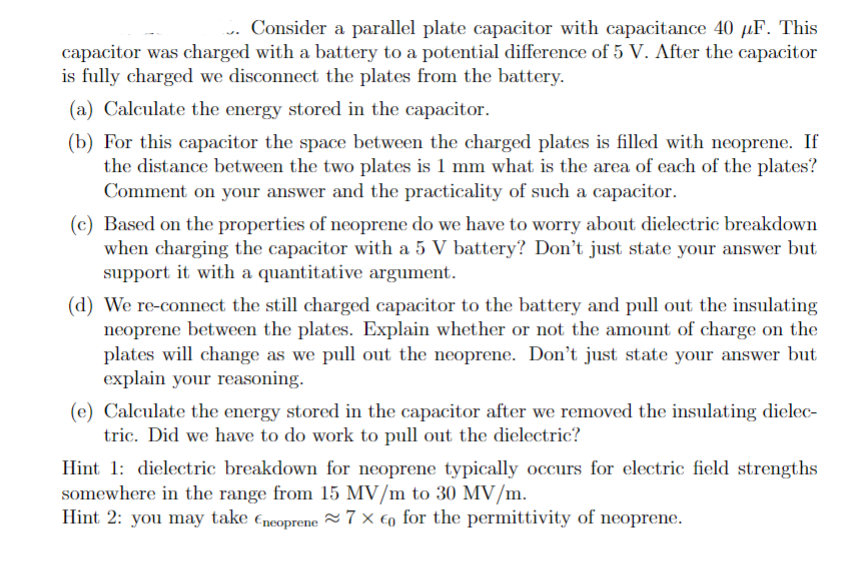
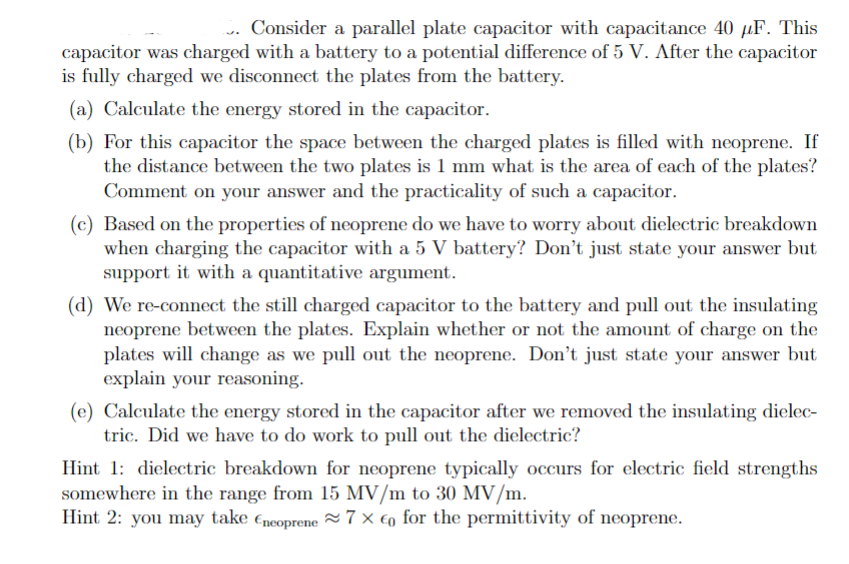
.. Consider a parallel plate capacitor with capacitance 40 itF. This capacitor was charged with a battery to a potential difference of a V. After the capacitor is fully charged we disconnect the plates from the battery. (a) Calculate the energy stored in the capacitor. (b) For this capacitor the space between the charged plates is lled with neoprene. If the distance between the two plates is 1 turn what is the area of each of the plates? Comment on your answer and the practicality of such a capacitor. {0) Based on the properties of neoprene do we have to worry about dielectric breakdown when charging the capacitor with a 5 V battery? Don't just state your answer but support it with a quantitative argument. (d) We re-eonnect the still charged capacitor to the battery and pull out the insulating neoprene between the plates. Explain whether or not the amount of charge on the plates will change as we pull out the neoprene. Don't just state your answer but explain your reasoning. (e) Calculate the energy stored in the capacitor after we removed the insulating dielec- tric. Did we have to do work to pull out the dielcxttric'.' Hint i: dielectric breakdown for neoprene typically occurs for electric eld strengths somewhere in the range from 15 MV/m to 3\" MVj'm. Hint 2: you may take 'mnc m T x en for the permittivity of neoprene
Step by Step Solution
There are 3 Steps involved in it

Get step-by-step solutions from verified subject matter experts
 Study Help