







Question: Consider a pension plan that will pay $10,000 once a year for a 5-year period (5 annual payments). The first payment will come in
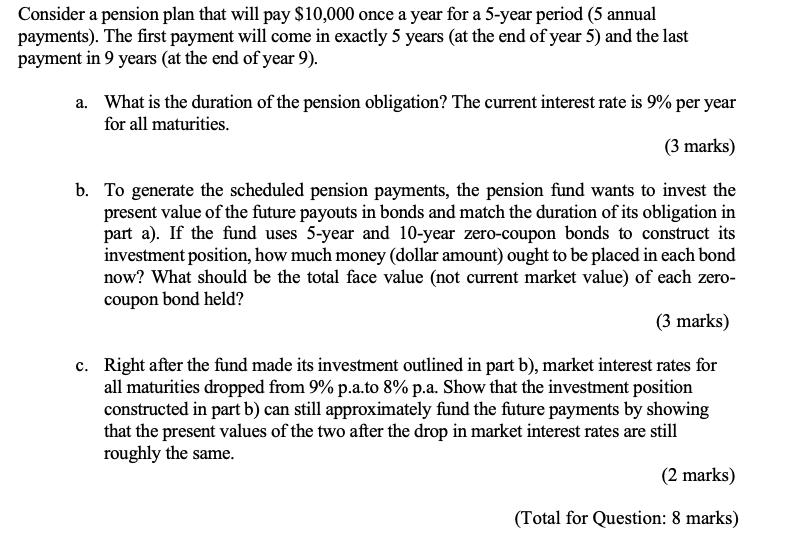
Consider a pension plan that will pay $10,000 once a year for a 5-year period (5 annual payments). The first payment will come in exactly 5 years (at the end of year 5) and the last payment in 9 years (at the end of year 9). a. What is the duration of the pension obligation? The current interest rate is 9% per year for all maturities. (3 marks) b. To generate the scheduled pension payments, the pension fund wants to invest the present value of the future payouts in bonds and match the duration of its obligation in part a). If the fund uses 5-year and 10-year zero-coupon bonds to construct its investment position, how much money (dollar amount) ought to be placed in each bond now? What should be the total face value (not current market value) of each zero- coupon bond held? (3 marks) c. Right after the fund made its investment outlined in part b), market interest rates for all maturities dropped from 9% p.a.to 8% p.a. Show that the investment position constructed in part b) can still approximately fund the future payments by showing that the present values of the two after the drop in market interest rates are still roughly the same. (2 marks) (Total for Question: 8 marks)
Step by Step Solution
There are 3 Steps involved in it
Solution a Duration of the Pension Obligation The pension obligation has a duration of 708 years Heres how to calculate it Present Value of Each Payme... View full answer

Get step-by-step solutions from verified subject matter experts
 Study Help