







Question: Consider a person sitting on a table with the back placed against a back rest and the lower legs free to rotate about the
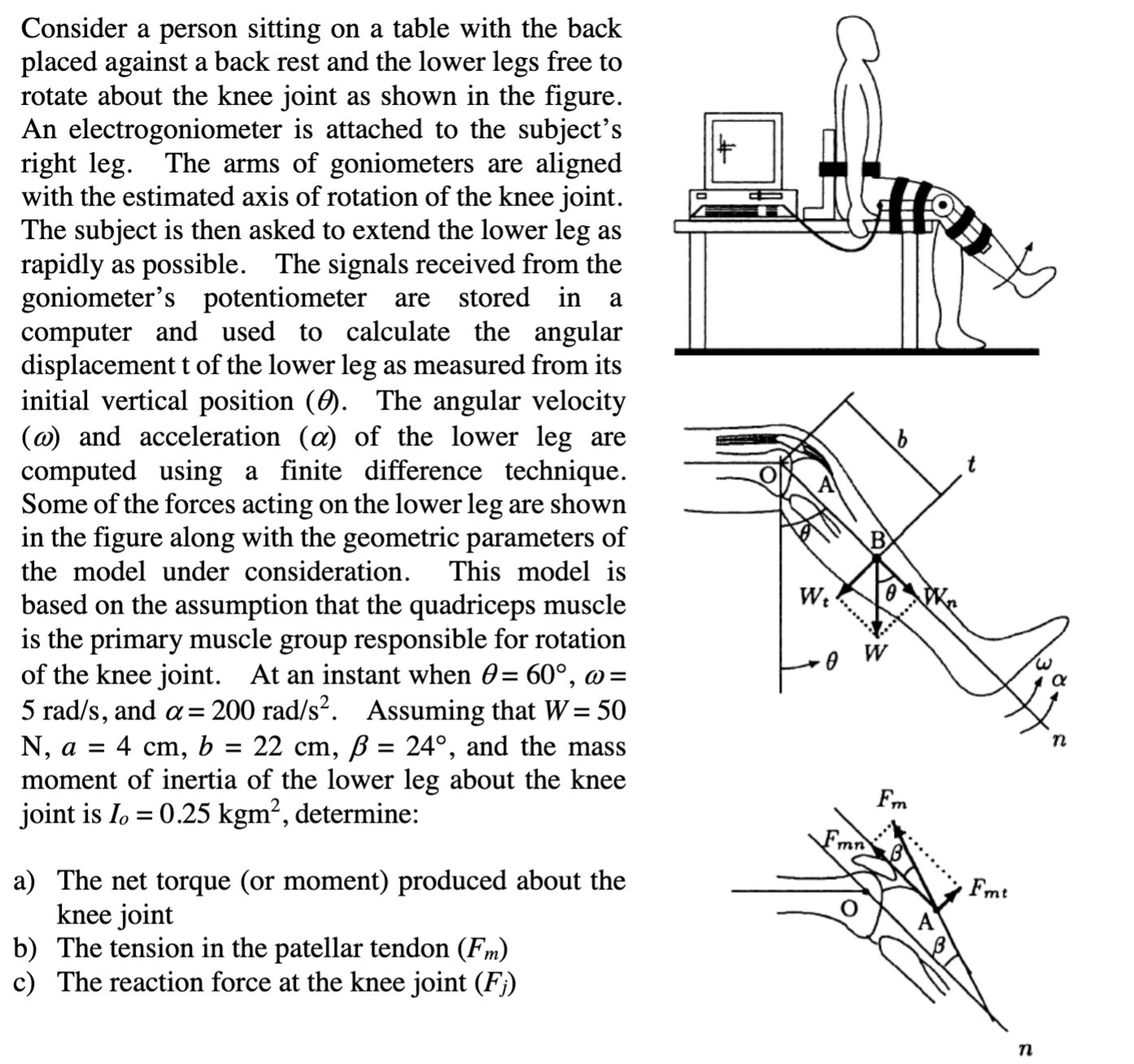
Consider a person sitting on a table with the back placed against a back rest and the lower legs free to rotate about the knee joint as shown in the figure. An electrogoniometer is attached to the subject's right leg. The arms of goniometers are aligned with the estimated axis of rotation of the knee joint. The subject is then asked to extend the lower leg as rapidly as possible. The signals received from the goniometer's potentiometer are stored in a computer and used to calculate the angular displacement t of the lower leg as measured from its initial vertical position (e). The angular velocity (@) and acceleration (a) of the lower leg are computed using a finite difference technique. Some of the forces acting on the lower leg are shown in the figure along with the geometric parameters of the model under consideration. This model is based on the assumption that the quadriceps muscle is the primary muscle group responsible for rotation of the knee joint. At an instant when 0 = 60, @= 5 rad/s, and = 200 rad/s. Assuming that W = 50 N, a = 4 cm, b = 22 cm, = 24, and the mass moment of inertia of the lower leg about the knee joint is I = 0.25 kgm, determine: a) The net torque (or moment) produced about the knee joint b) The tension in the patellar tendon (Fm) c) The reaction force at the knee joint (F;) + W mn W Fm ........... A Fmt n
Step by Step Solution
There are 3 Steps involved in it

Get step-by-step solutions from verified subject matter experts
 Study Help