







Question: Consider a pipelined processor that performs the five basic operations of Instruction Fetch, Decode / Register Read, Execute, Memory and Register Write in more than
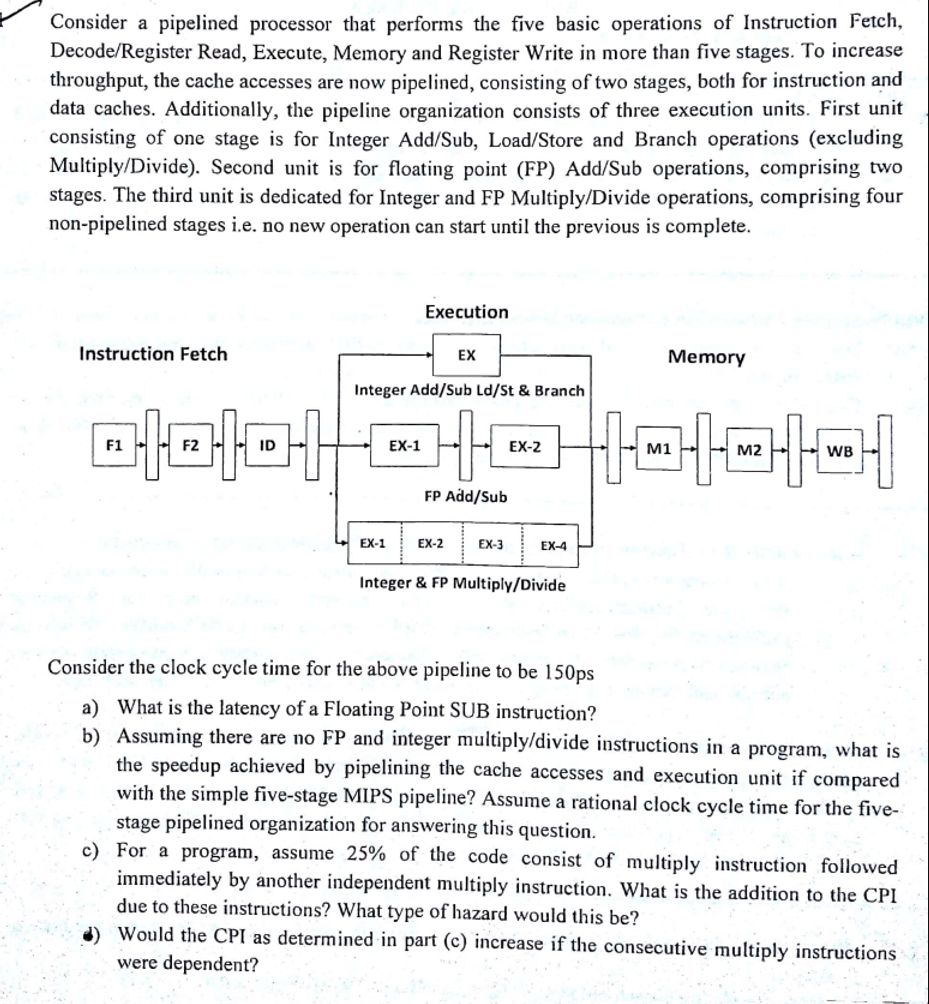
Consider a pipelined processor that performs the five basic operations of Instruction Fetch,
DecodeRegister Read, Execute, Memory and Register Write in more than five stages. To increase
throughput, the cache accesses are now pipelined, consisting of two stages, both for instruction and
data caches. Additionally, the pipeline organization consists of three execution units. First unit
consisting of one stage is for Integer AddSub LoadStore and Branch operations excluding
MultiplyDivide Second unit is for floating point FP AddSub operations, comprising two
stages. The third unit is dedicated for Integer and FP MultiplyDivide operations, comprising four
nonpipelined stages ie no new operation can start until the previous is complete.
Consider the clock cycle time for the above pipeline to be
a What is the latency of a Floating Point SUB instruction?
b Assuming there are no FP and integer multiplydivide instructions in a program, what is
the speedup achieved by pipelining the cache accesses and execution unit if compared
with the simple fivestage MIPS pipeline? Assume a rational clock cycle time for the five
stage pipelined organization for answering this question.
c For a program, assume of the code consist of multiply instruction followed
immediately by another independent multiply instruction. What is the addition to the CPI
due to these instructions? What type of hazard would this be
d Would the CPI as determined in part c increase if the consecutive multiply instructions
were dependent?
Step by Step Solution
There are 3 Steps involved in it
1 Expert Approved Answer
Step: 1 Unlock

Question Has Been Solved by an Expert!
Get step-by-step solutions from verified subject matter experts
Step: 2 Unlock
Step: 3 Unlock
 Study Help