



Question: Consider a positive charge q and a negative charge -q , separated by a distance, d . The z -axis passes through both charges, and
Consider a positive charge
qand a negative charge
-q, separated by a distance,
d. The
z-axis passes through both charges, and the origin,
z=0, is at the midpoint between the two charges.\ a) Draw the configuration.\ b) Obtain a symbolic expression for the electric field at a point on the
z-axis at arbitrary location,
z. Express your answer in simplest form.\ c) Show that if
z>>dthe electric field is proportional to
(1)/(z^(3)).\ d) What is the electric field at an arbitrary point on the line perpendicular to the
z-axis that passes through
z=0? You need a coordinate along this line, so let's call it
x. How does this expression behave when
x>>d?
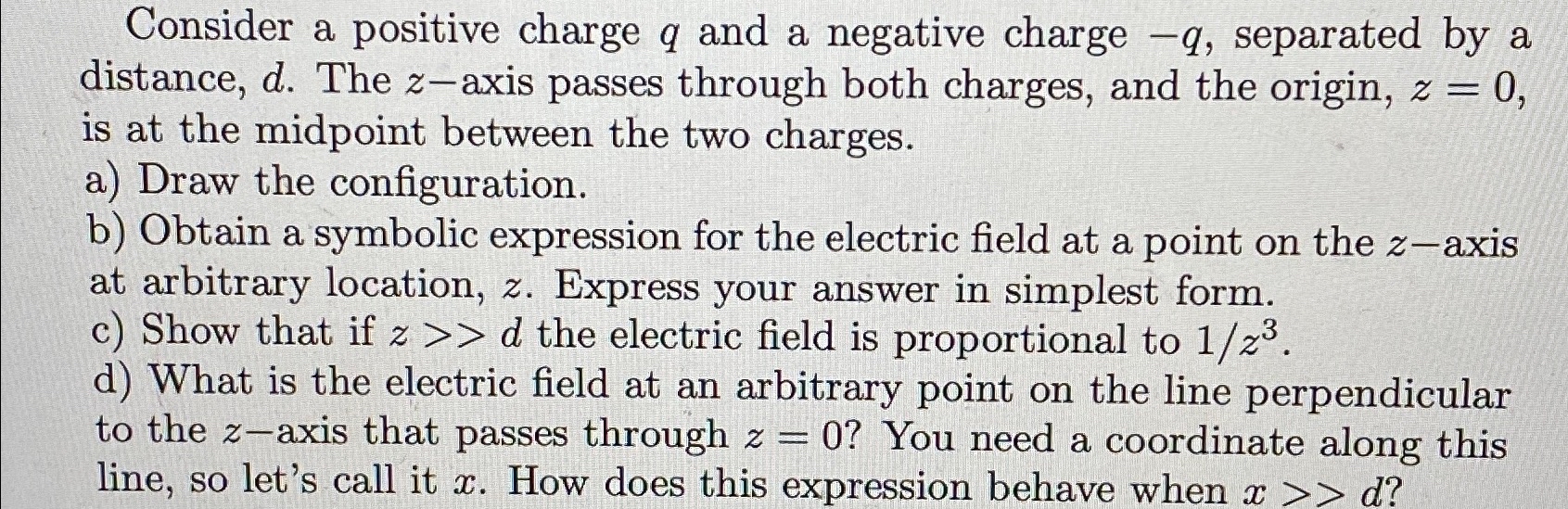
Consider a positive charge q and a negative charge q, separated by a distance, d. The z-axis passes through both charges, and the origin, z=0, is at the midpoint between the two charges. a) Draw the configuration. b) Obtain a symbolic expression for the electric field at a point on the z-axis at arbitrary location, z. Express your answer in simplest form. c) Show that if z>>d the electric field is proportional to 1/z3. d) What is the electric field at an arbitrary point on the line perpendicular to the z-axis that passes through z=0 ? You need a coordinate along this line, so let's call it x. How does this expression behave when x>>d ? Consider a positive charge q and a negative charge q, separated by a distance, d. The z-axis passes through both charges, and the origin, z=0, is at the midpoint between the two charges. a) Draw the configuration. b) Obtain a symbolic expression for the electric field at a point on the z-axis at arbitrary location, z. Express your answer in simplest form. c) Show that if z>>d the electric field is proportional to 1/z3. d) What is the electric field at an arbitrary point on the line perpendicular to the z-axis that passes through z=0 ? You need a coordinate along this line, so let's call it x. How does this expression behave when x>>d
Step by Step Solution
There are 3 Steps involved in it

Get step-by-step solutions from verified subject matter experts