







Question: Consider a quantum simple harmonic oscillator with time-dependent fre- quency and Hamiltonian Let w w (t) = p H 2m + m (1)x. t
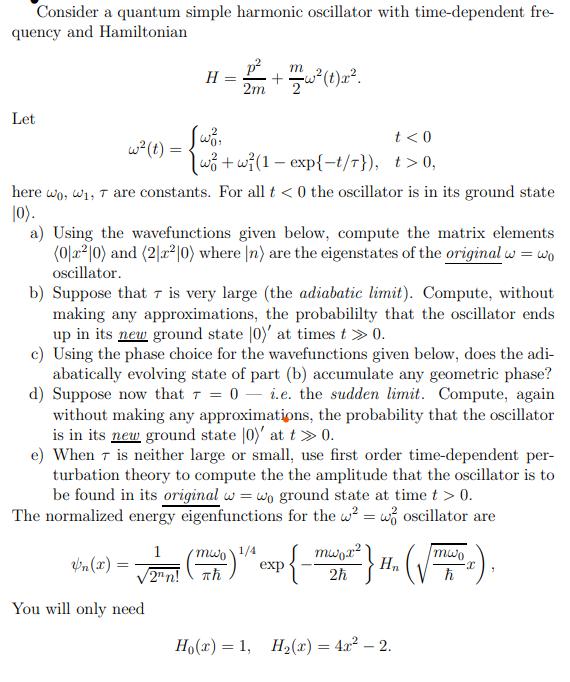
Consider a quantum simple harmonic oscillator with time-dependent fre- quency and Hamiltonian Let w w (t) = p H 2m + m (1)x. t 0, here wo, w, T are constants. For all t < 0 the oscillator is in its ground state |0). a) Using the wavefunctions given below, compute the matrix elements (0x210) and (2210) where [n) are the eigenstates of the original w = wo oscillator. b) Suppose that is very large (the adiabatic limit). Compute, without making any approximations, the probabililty that the oscillator ends up in its new ground state [0)' at times t>0. c) Using the phase choice for the wavefunctions given below, does the adi- abatically evolving state of part (b) accumulate any geometric phase? d) Suppose now that 70 i.e. the sudden limit. Compute, again without making any approximations, the probability that the oscillator is in its new ground state (0)' at t > 0. e) When is neither large or small, use first order time-dependent per- turbation theory to compute the the amplitude that the oscillator is to be found in its original w = wo ground state at time t > 0. The normalized energy eigenfunctions for the w = w oscillator are 1 mw 1/4 Vn(x) exp 2nn! Th {- mwo.x2 mwo Hn 2h h You will only need Ho(a) 1, H2(x) = 4x - 2. =
Step by Step Solution
3.41 Rating (157 Votes )
There are 3 Steps involved in it
I see the image contains a question regarding the quantum harmonic oscillator with a timedependent frequency including a set of subquestions ae Due to ... View full answer

Get step-by-step solutions from verified subject matter experts
 Study Help