





Question: Consider a queueing system with two servers A and B where jobs arrive as a Poisson process at a rate of 20 jobs per hour.
Consider a queueing system with two servers A and

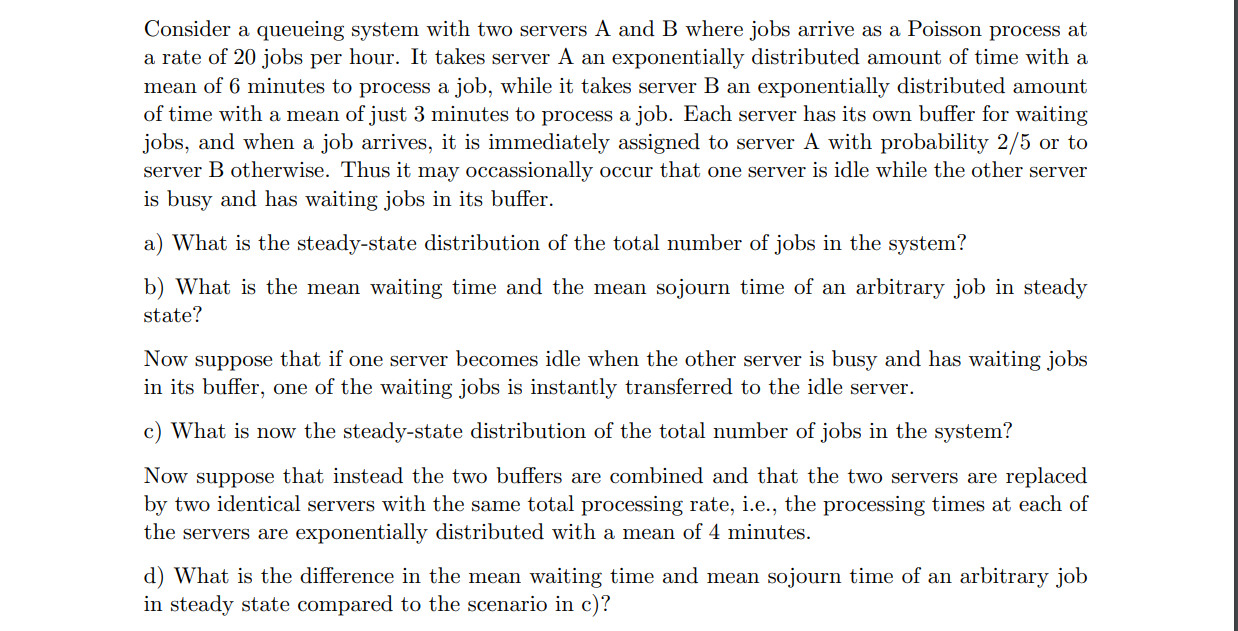
Consider a queueing system with two servers A and B where jobs arrive as a Poisson process at a rate of 20 jobs per hour. It takes server A an exponentially distributed amount of time with a mean of 6 minutes to process a job, while it takes server B an exponentially distributed amount of time with a mean of just 3 minutes to process a job. Each server has its own buffer for waiting jobs, and when a job arrives, it is immediately assigned to server A with probability 2/5 or to server B otherwise. Thus it may occassionally occur that one server is idle while the other server is busy and has waiting jobs in its buffer. a) What is the steady-state distribution of the total number of jobs in the system? b) What is the mean waiting time and the mean sojourn time of an arbitrary job in steady state? Now suppose that if one server becomes idle when the other server is busy and has waiting jobs in its buffer, one of the waiting jobs is instantly transferred to the idle server. c) What is now the steady-state distribution of the total number of jobs in the system? Now suppose that instead the two buffers are combined and that the two servers are replaced by two identical servers with the same total processing rate, i.e., the processing times at each of the servers are exponentially distributed with a mean of 4 minutes. d) What is the difference in the mean waiting time and mean sojourn time of an arbitrary job in steady state compared to the scenario in c)

Step by Step Solution

There are 3 Steps involved in it

1 Expert Approved Answer
Step: 1 Unlock blur-text-image

Question Has Been Solved by an Expert!

Get step-by-step solutions from verified subject matter experts

Step: 2 Unlock
Step: 3 Unlock

Students Have Also Explored These Related General Management Questions!