







Question: Consider a single period problem where demand has probability density function f(.), the item costs c dollars per unit, sells for a price of p
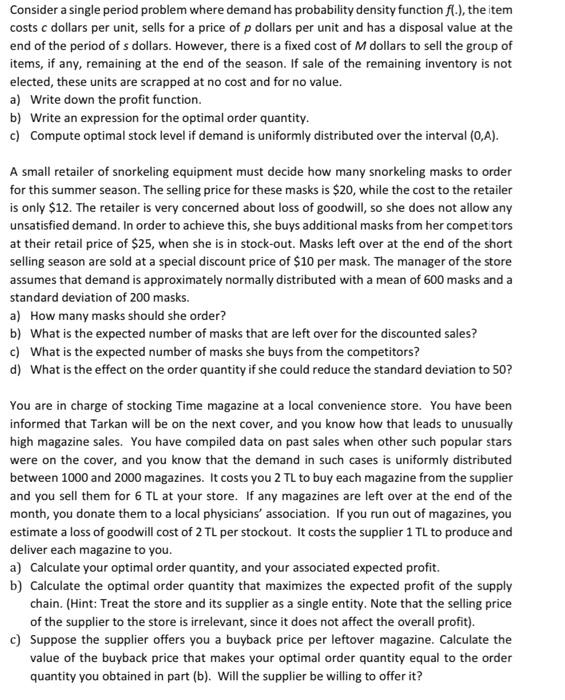
Consider a single period problem where demand has probability density function f(.), the item costs c dollars per unit, sells for a price of p dollars per unit and has a disposal value at the end of the period of s dollars. However, there is a fixed cost of M dollars to sell the group of items, if any, remaining at the end of the season. If sale of the remaining inventory is not elected, these units are scrapped at no cost and for no value. a) Write down the profit function. b) Write an expression for the optimal order quantity. c) Compute optimal stock level if demand is uniformly distributed over the interval (0,A). A small retailer of snorkeling equipment must decide how many snorkeling masks to order for this summer season. The selling price for these masks is $20, while the cost to the retailer is only $12. The retailer is very concerned about loss of goodwill, so she does not allow any unsatisfied demand. In order to achieve this, she buys additional masks from her competitors at their retail price of $25, when she is in stock-out. Masks left over at the end of the short selling season are sold at a special discount price of $10 per mask. The manager of the store assumes that demand is approximately normally distributed with a mean of 600 masks and a standard deviation of 200 masks. a) How many masks should she order? b) What is the expected number of masks that are left over for the discounted sales? c) What is the expected number of masks she buys from the competitors? d) What is the effect on the order quantity if she could reduce the standard deviation to 50? You are in charge of stocking Time magazine at a local convenience store. You have been informed that Tarkan will be on the next cover, and you know how that leads to unusually high magazine sales. You have compiled data on past sales when other such popular stars were on the cover, and you know that the demand in such cases is uniformly distributed between 1000 and 2000 magazines. It costs you 2 TL to buy each magazine from the supplier and you sell them for 6 TL at your store. If any magazines are left over at the end of the month, you donate them to a local physicians' association. If you run out of magazines, you estimate a loss of goodwill cost of 2 TL per stockout. It costs the supplier 1 TL to produce and deliver each magazine to you. a) Calculate your optimal order quantity, and your associated expected profit. b) Calculate the optimal order quantity that maximizes the expected profit of the supply chain. (Hint: Treat the store and its supplier as a single entity. Note that the selling price of the supplier to the store is irrelevant, since it does not affect the overall profit). c) Suppose the supplier offers you a buyback price per leftover magazine. Calculate the value of the buyback price that makes your optimal order quantity equal to the order quantity you obtained in part (b). Will the supplier be willing to offer it? Consider a single period problem where demand has probability density function f(.), the item costs c dollars per unit, sells for a price of p dollars per unit and has a disposal value at the end of the period of s dollars. However, there is a fixed cost of M dollars to sell the group of items, if any, remaining at the end of the season. If sale of the remaining inventory is not elected, these units are scrapped at no cost and for no value. a) Write down the profit function. b) Write an expression for the optimal order quantity. c) Compute optimal stock level if demand is uniformly distributed over the interval (0,A). A small retailer of snorkeling equipment must decide how many snorkeling masks to order for this summer season. The selling price for these masks is $20, while the cost to the retailer is only $12. The retailer is very concerned about loss of goodwill, so she does not allow any unsatisfied demand. In order to achieve this, she buys additional masks from her competitors at their retail price of $25, when she is in stock-out. Masks left over at the end of the short selling season are sold at a special discount price of $10 per mask. The manager of the store assumes that demand is approximately normally distributed with a mean of 600 masks and a standard deviation of 200 masks. a) How many masks should she order? b) What is the expected number of masks that are left over for the discounted sales? c) What is the expected number of masks she buys from the competitors? d) What is the effect on the order quantity if she could reduce the standard deviation to 50? You are in charge of stocking Time magazine at a local convenience store. You have been informed that Tarkan will be on the next cover, and you know how that leads to unusually high magazine sales. You have compiled data on past sales when other such popular stars were on the cover, and you know that the demand in such cases is uniformly distributed between 1000 and 2000 magazines. It costs you 2 TL to buy each magazine from the supplier and you sell them for 6 TL at your store. If any magazines are left over at the end of the month, you donate them to a local physicians' association. If you run out of magazines, you estimate a loss of goodwill cost of 2 TL per stockout. It costs the supplier 1 TL to produce and deliver each magazine to you. a) Calculate your optimal order quantity, and your associated expected profit. b) Calculate the optimal order quantity that maximizes the expected profit of the supply chain. (Hint: Treat the store and its supplier as a single entity. Note that the selling price of the supplier to the store is irrelevant, since it does not affect the overall profit). c) Suppose the supplier offers you a buyback price per leftover magazine. Calculate the value of the buyback price that makes your optimal order quantity equal to the order quantity you obtained in part (b). Will the supplier be willing to offer it
Step by Step Solution
There are 3 Steps involved in it

Get step-by-step solutions from verified subject matter experts
 Study Help