Question: Consider a system consisting of eight components (A, B, C, D, E, F, G, and H) that are configured as shown in the following figure.
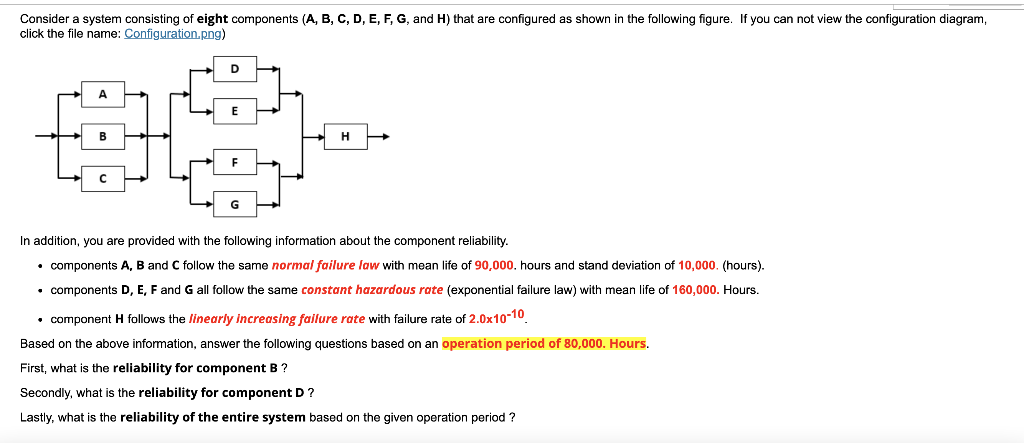
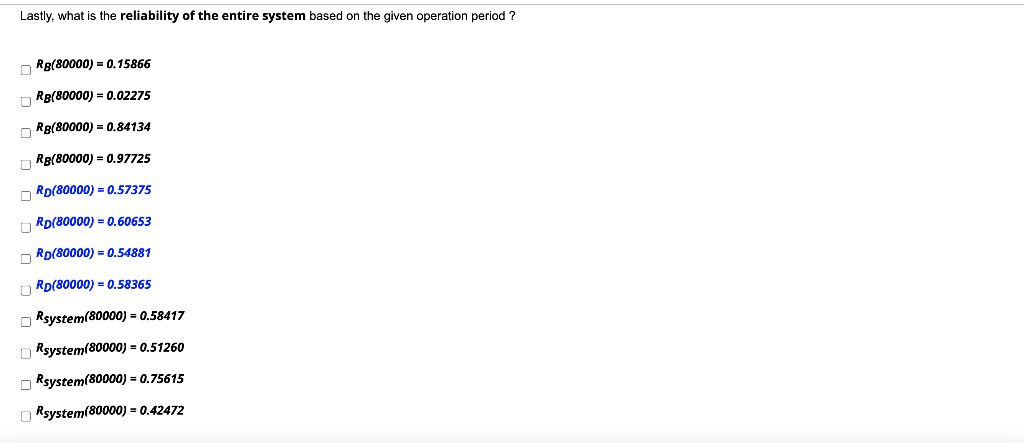
Consider a system consisting of eight components (A, B, C, D, E, F, G, and H) that are configured as shown in the following figure. If you can not view the configuration diagram, click the file name: Configuration.png) D A E H F G In addition, you are provided with the following information about the component reliability. components A, B and C follow the same normal failure law with mean life of 90,000. hours and stand deviation of 10,000. (hours). components D, E, F and G all follow the same constant hazardous rate (exponential failure law) with mean life of 160,000. Hours. component H follows the linearly increasing failure rate with failure rate of 2.0x10⁻¹⁰ Based on the above information, answer the following questions based on an operation period of 80,000. Hours. First, what is the reliability for component B? Secondly, what is the reliability for component D? Lastly, what is the reliability of the entire system based on the given operation period ? Lastly, what is the reliability of the entire system based on the given operation period ? RB(80000) = 0.15866 RB[80000) = 0.02275 R8(80000) = 0.84134 R8(80000) = 0.97725 RD(80000) = 0.57375 RD(80000) = 0.60653 RD(80000) = 0.54881 RD(80000) = 0.58365 Rsystem(80000) = 0.58417 Rsystem(80000) = 0.51260 Rsystem(80000) = 0.75615 Rsystem(80000) = 0.42472 Consider a system consisting of eight components (A, B, C, D, E, F, G, and H) that are configured as shown in the following figure. If you can not view the configuration diagram, click the file name: Configuration.png) D A E H F G In addition, you are provided with the following information about the component reliability. components A, B and C follow the same normal failure law with mean life of 90,000. hours and stand deviation of 10,000. (hours). components D, E, F and G all follow the same constant hazardous rate (exponential failure law) with mean life of 160,000. Hours. component H follows the linearly increasing failure rate with failure rate of 2.0x10⁻¹⁰ Based on the above information, answer the following questions based on an operation period of 80,000. Hours. First, what is the reliability for component B? Secondly, what is the reliability for component D? Lastly, what is the reliability of the entire system based on the given operation period ? Lastly, what is the reliability of the entire system based on the given operation period ? RB(80000) = 0.15866 RB[80000) = 0.02275 R8(80000) = 0.84134 R8(80000) = 0.97725 RD(80000) = 0.57375 RD(80000) = 0.60653 RD(80000) = 0.54881 RD(80000) = 0.58365 Rsystem(80000) = 0.58417 Rsystem(80000) = 0.51260 Rsystem(80000) = 0.75615 Rsystem(80000) = 0.42472









 Study Help