







Question: Part 1: Schedule design Problem 1: Consider a simple three-step manufacturing process as illustrated in the given figure. Assuming that demand is 1,000 units, what
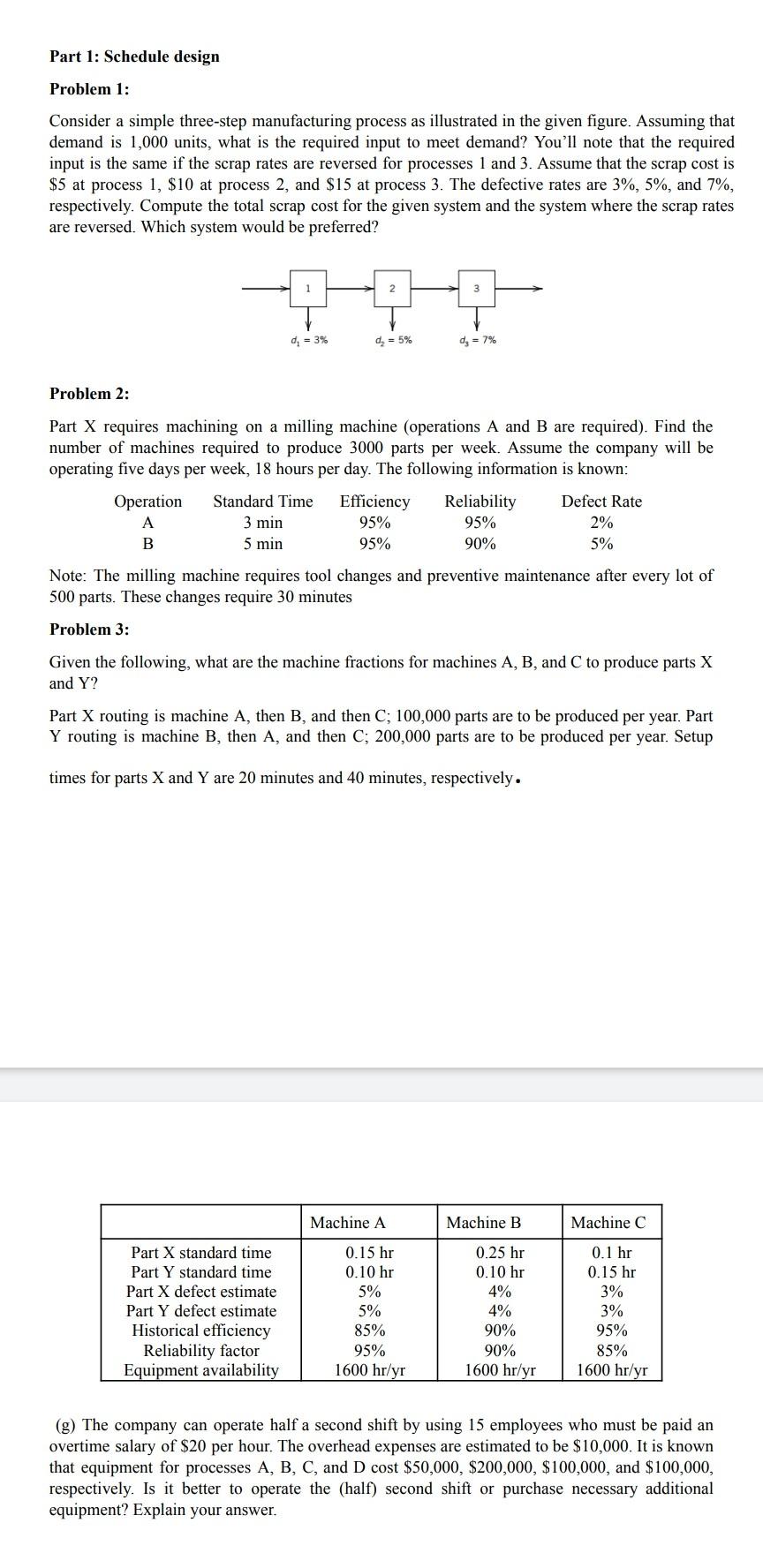
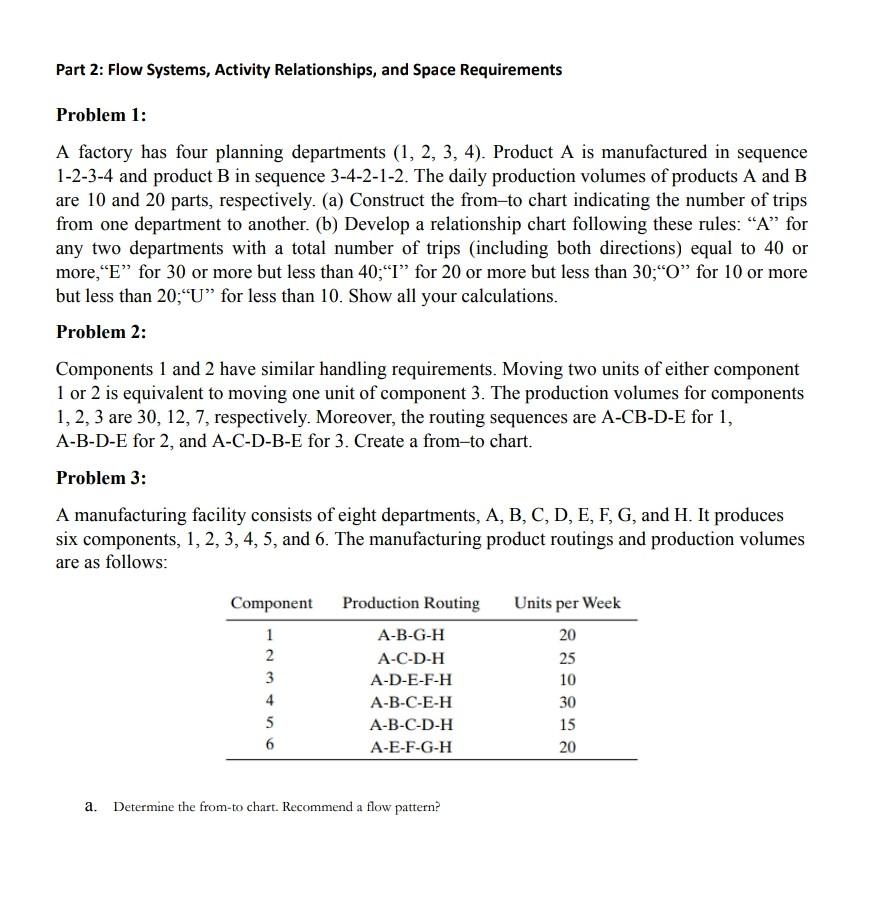
Part 1: Schedule design Problem 1: Consider a simple three-step manufacturing process as illustrated in the given figure. Assuming that demand is 1,000 units, what is the required input to meet demand? You'll note that the required input is the same if the scrap rates are reversed for processes 1 and 3. Assume that the scrap cost is $5 at process 1,$10 at process 2 , and $15 at process 3 . The defective rates are 3%,5%, and 7%, respectively. Compute the total scrap cost for the given system and the system where the scrap rates are reversed. Which system would be preferred? Problem 2: Part X requires machining on a milling machine (operations A and B are required). Find the number of machines required to produce 3000 parts per week. Assume the company will be operating five days per week, 18 hours per day. The following information is known: Note: The milling machine requires tool changes and preventive maintenance after every lot of 500 parts. These changes require 30 minutes Problem 3: Given the following, what are the machine fractions for machines A, B, and C to produce parts X and Y ? Part X routing is machine A, then B, and then C;100,000 parts are to be produced per year. Part Y routing is machine B, then A, and then C;200,000 parts are to be produced per year. Setup times for parts X and Y are 20 minutes and 40 minutes, respectively. (g) The company can operate half a second shift by using 15 employees who must be paid an overtime salary of $20 per hour. The overhead expenses are estimated to be $10,000. It is known that equipment for processes A,B,C, and D cost $50,000,$200,000,$100,000, and $100,000, respectively. Is it better to operate the (half) second shift or purchase necessary additional equipment? Explain your answer. Part 2: Flow Systems, Activity Relationships, and Space Requirements Problem 1: A factory has four planning departments (1,2,3,4). Product A is manufactured in sequence 1-2-3-4 and product B in sequence 3-4-2-1-2. The daily production volumes of products A and B are 10 and 20 parts, respectively. (a) Construct the from-to chart indicating the number of trips from one department to another. (b) Develop a relationship chart following these rules: " A " for any two departments with a total number of trips (including both directions) equal to 40 or more, "E" for 30 or more but less than 40 ;" I " for 20 or more but less than 30 ;" O " for 10 or more but less than 20 ;"U" for less than 10 . Show all your calculations. Problem 2: Components 1 and 2 have similar handling requirements. Moving two units of either component 1 or 2 is equivalent to moving one unit of component 3 . The production volumes for components 1,2,3 are 30,12,7, respectively. Moreover, the routing sequences are A-CB-D-E for 1, A-B-D-E for 2, and A-C-D-B-E for 3. Create a from-to chart. Problem 3: A manufacturing facility consists of eight departments, A, B, C, D, E, F, G, and H. It produces six components, 1,2,3,4,5, and 6 . The manufacturing product routings and production volumes are as follows: a. Determine the from-to chart. Recommend a flow pattern
Step by Step Solution
There are 3 Steps involved in it

Get step-by-step solutions from verified subject matter experts
 Study Help