







Question: Consider a thin, circular disc of radius a, which rotates at a constant angular velocity o about the z axis, which is perpendicular to
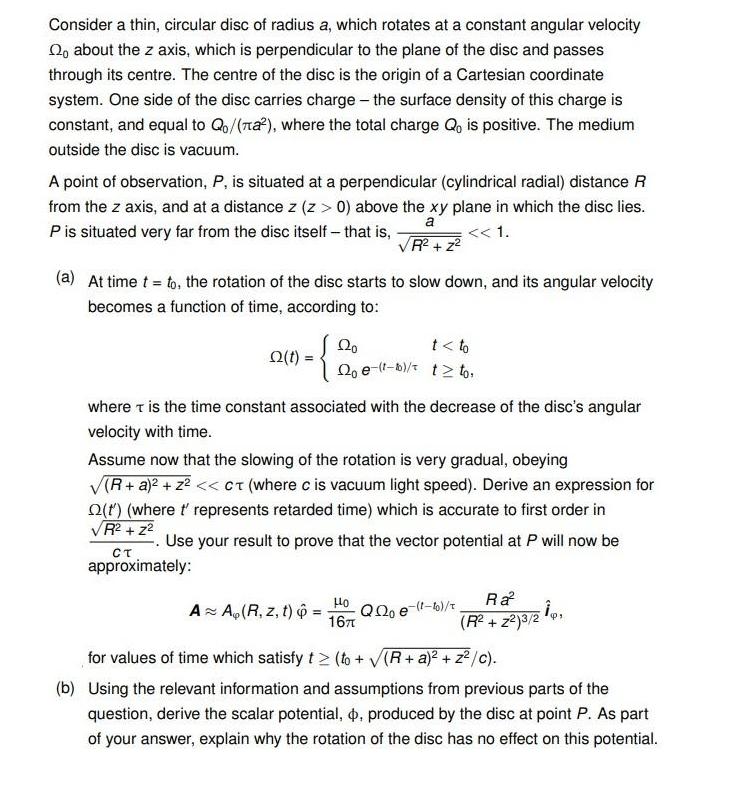
Consider a thin, circular disc of radius a, which rotates at a constant angular velocity o about the z axis, which is perpendicular to the plane of the disc and passes through its centre. The centre of the disc is the origin of a Cartesian coordinate system. One side of the disc carries charge - the surface density of this charge is constant, and equal to Qo/(ra), where the total charge Q, is positive. The medium outside the disc is vacuum. A point of observation, P, is situated at a perpendicular (cylindrical radial) distance R from the z axis, and at a distance z (z > 0) above the xy plane in which the disc lies. P is situated very far from the disc itself - that is, a < < 1. R + 2 (a) At time t = to, the rotation of the disc starts to slow down, and its angular velocity becomes a function of time, according to: Q(t): { CT approximately: Qoe-(1-b)/ where T is the time constant associated with the decrease of the disc's angular velocity with time. Assume now that the slowing of the rotation is very gradual, obeying (R+ a) + z < < CT (where c is vacuum light speed). Derive an expression for (t) (where t' represents retarded time) which is accurate to first order in R + z Use your result to prove that the vector potential at P will now be t < to tz to, A A(R, z, t) = Ho 167T Qoe-(-6)/ Ra (R +22)3/2 for values of time which satisfy t> (to + (R+ a) + 2/c). (b) Using the relevant information and assumptions from previous parts of the question, derive the scalar potential, , produced by the disc at point P. As part of your answer, explain why the rotation of the disc has no effect on this potential.
Step by Step Solution
3.51 Rating (164 Votes )
There are 3 Steps involved in it
Lets start by addressing part a of your question You are given the expression for the angular velocity of the disc which changes over time t 0 for t t0 and 0 ett0 for t t0 Since the disc is slowing do... View full answer

Get step-by-step solutions from verified subject matter experts
 Study Help