







Question: Consider a three-period model, with t = 0 representing the first date and t = 3 the last date. There are two assets: the risk-free
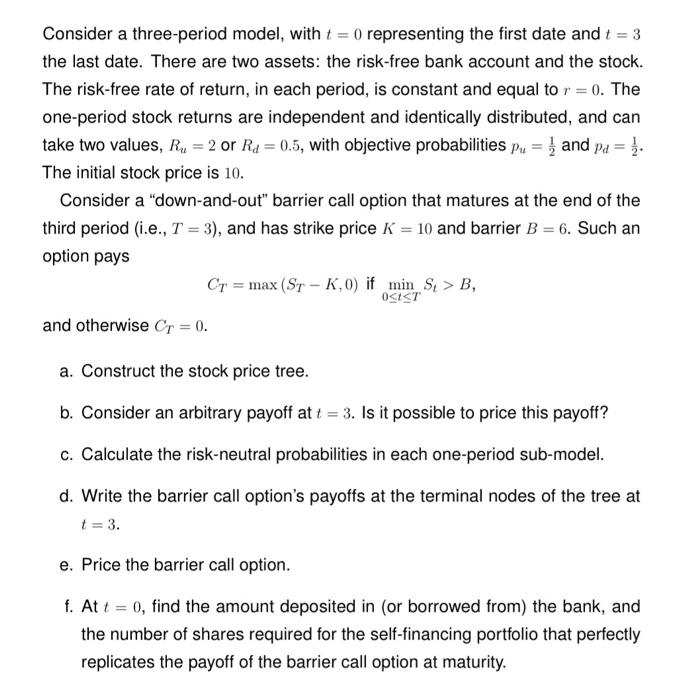
Consider a three-period model, with t = 0 representing the first date and t = 3 the last date. There are two assets: the risk-free bank account and the stock. The risk-free rate of return, in each period, is constant and equal to r = 0. The one-period stock returns are independent and identically distributed, and can take two values, Ru = 2 or Rd = 0.5, with objective probabilities pu = ? and pa = 1. The initial stock price is 10. Consider a "down-and-out" barrier call option that matures at the end of the third period (i.e., T = 3), and has strike price K = 10 and barrier B = 6. Such an option pays Cr=max (Sr - K,0) if min Se>B, 0
Step by Step Solution
There are 3 Steps involved in it

Get step-by-step solutions from verified subject matter experts
 Study Help