







Question: Consider a two period model, populated by a representative consumer and a government. The consumer's preferences can be described by the utility function: u(C0, C1)=(C0^.5)+B(C1^.5)
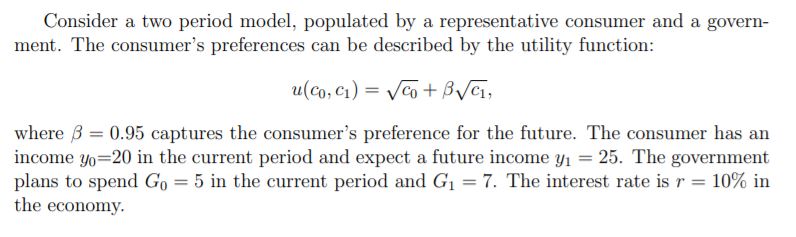
Consider a two period model, populated by a representative consumer and a government. The consumer's preferences can be described by the utility function:
u(C0, C1)=(C0^.5)+B(C1^.5)
where B = 0.95 captures the consumer's preference for the future. The consumer has an income Y0=20 in the current period and expect a future income Y1 = 25. The government plans to spend G0 = 5 in the current period and G1 = 7. The interest rate is r 10% in the economy.
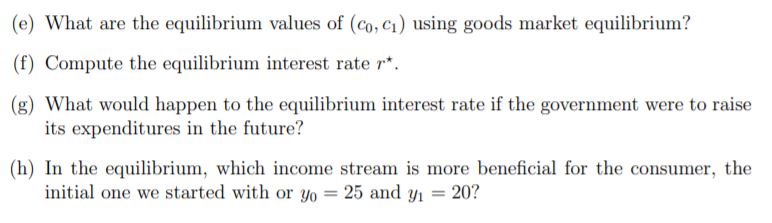
(e) What are the equilibrium values of (C0,C1) using goods market equilibrium?
(f) Compute the equilibrium interest rate r*
(g) What would happen to the equilibrium interest rate if the government were to raise its expenditures in the future?
(h) In the equilibrium, which income stream is more beneficial for the consumer, the initial one we started with or Y0 = 25 and Y1 = 20?
Step by Step Solution
There are 3 Steps involved in it

Get step-by-step solutions from verified subject matter experts
 Study Help