







Question: Consider a two-period model with t = {0,1}. The agent derives utility In(c) from consumption c in period t. The utility function u is
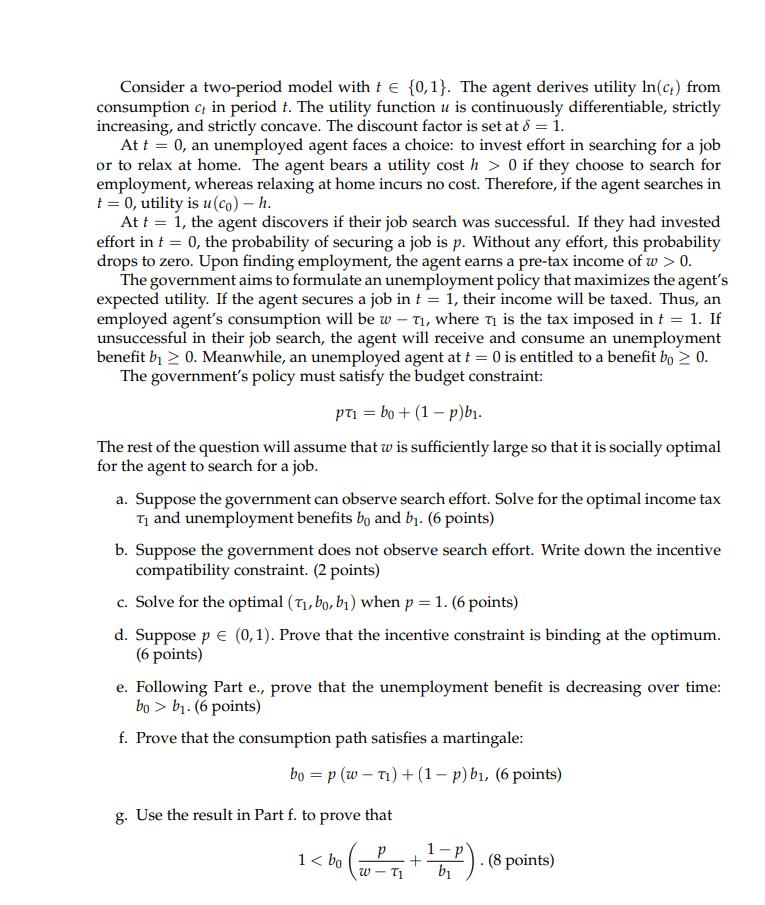
Consider a two-period model with t = {0,1}. The agent derives utility In(c) from consumption c in period t. The utility function u is continuously differentiable, strictly increasing, and strictly concave. The discount factor is set at 8 = 1. At t = 0, an unemployed agent faces a choice: to invest effort in searching for a job or to relax at home. The agent bears a utility cost h > 0 if they choose to search for employment, whereas relaxing at home incurs no cost. Therefore, if the agent searches in t = 0, utility is u (co) - h. At t = 1, the agent discovers if their job search was successful. If they had invested effort in t = 0, the probability of securing a job is p. Without any effort, this probability drops to zero. Upon finding employment, the agent earns a pre-tax income of w > 0. The government aims to formulate an unemployment policy that maximizes the agent's expected utility. If the agent secures a job in t = 1, their income will be taxed. Thus, an employed agent's consumption will be w- T, where T is the tax imposed in t = 1. If unsuccessful in their job search, the agent will receive and consume an unemployment benefit b 0. Meanwhile, an unemployed agent at t = 0 is entitled to a benefit bo 0. The government's policy must satisfy the budget constraint: pti bo+ (1 - p)bi. The rest of the question will assume that w is sufficiently large so that it is socially optimal for the agent to search for a job. a. Suppose the government can observe search effort. Solve for the optimal income tax T and unemployment benefits bo and b. (6 points) b. Suppose the government does not observe search effort. Write down the incentive compatibility constraint. (2 points) c. Solve for the optimal (T1, bo, b) when p = 1. (6 points) d. Suppose p = (0,1). Prove that the incentive constraint is binding at the optimum. (6 points) e. Following Part e., prove that the unemployment benefit is decreasing over time: bo> b. (6 points) f. Prove that the consumption path satisfies a martingale: bop (w-1)+(1 - p) b, (6 points) g. Use the result in Part f. to prove that 1 < bo ( P + w- b 1-57). (8 points)
Step by Step Solution
There are 3 Steps involved in it

Get step-by-step solutions from verified subject matter experts
 Study Help