







Question: Consider a worker, Andy, who has typical indifference curves representing his preference over consumption and leisure. a. Illustrate Andy's budget constraint, his choice, and
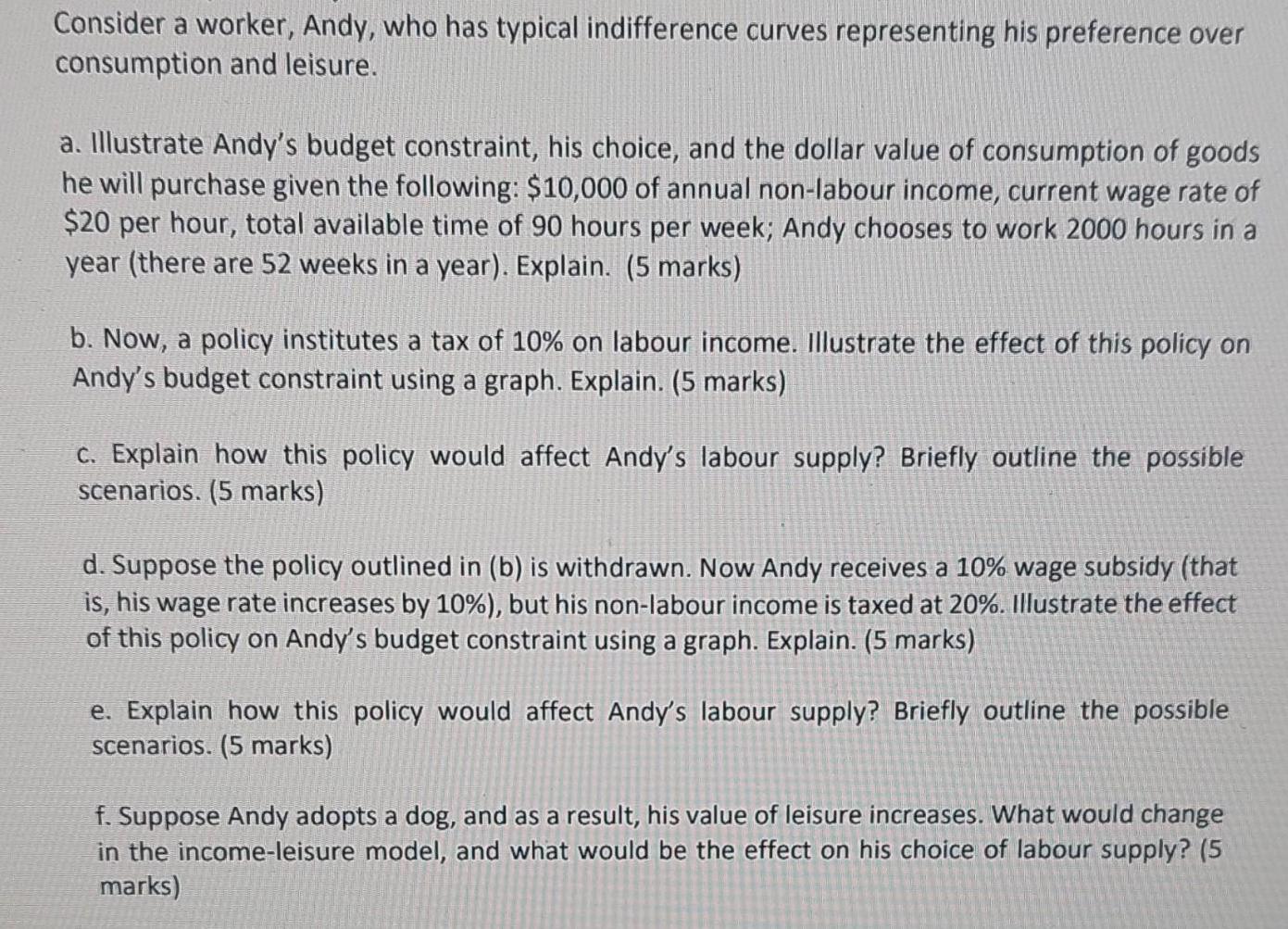
Consider a worker, Andy, who has typical indifference curves representing his preference over consumption and leisure. a. Illustrate Andy's budget constraint, his choice, and the dollar value of consumption of goods he will purchase given the following: $10,000 of annual non-labour income, current wage rate of $20 per hour, total available time of 90 hours per week; Andy chooses to work 2000 hours in a year (there are 52 weeks in a year). Explain. (5 marks) b. Now, a policy institutes a tax of 10% on labour income. Illustrate the effect of this policy on Andy's budget constraint using a graph. Explain. (5 marks) c. Explain how this policy would affect Andy's labour supply? Briefly outline the possible scenarios. (5 marks) d. Suppose the policy outlined in (b) is withdrawn. Now Andy receives a 10% wage subsidy (that is, his wage rate increases by 10%), but his non-labour income is taxed at 20%. Illustrate the effect of this policy on Andy's budget constraint using a graph. Explain. (5 marks) e. Explain how this policy would affect Andy's labour supply? Briefly outline the possible scenarios. (5 marks) f. Suppose Andy adopts a dog, and as a result, his value of leisure increases. What would change in the income-leisure model, and what would be the effect on his choice of labour supply? (5 marks)
Step by Step Solution
3.53 Rating (160 Votes )
There are 3 Steps involved in it
6 a The consumer budget constraint is given as C wTL A Here C represents consumption w represents th... View full answer

Get step-by-step solutions from verified subject matter experts
 Study Help