







Question: Consider an audio system which has an audio sensor interfaced to it. The job of the audio system is to collect the audio signal,
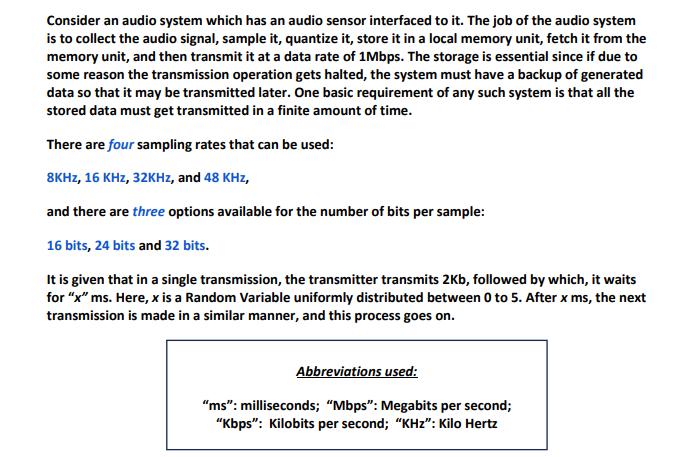
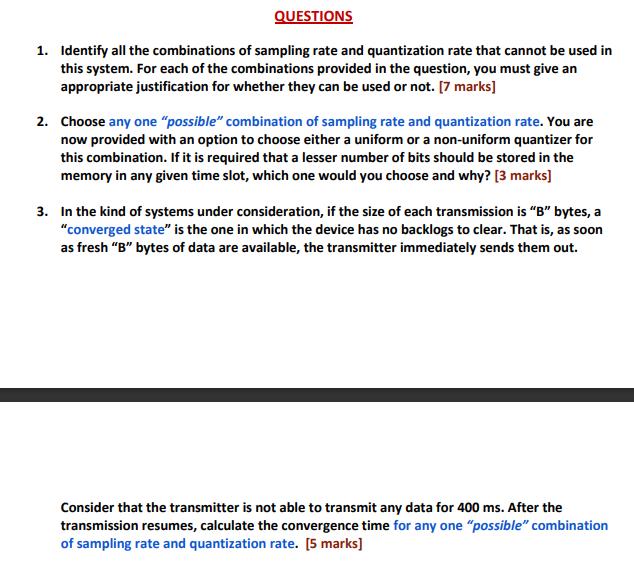
Consider an audio system which has an audio sensor interfaced to it. The job of the audio system is to collect the audio signal, sample it, quantize it, store it in a local memory unit, fetch it from the memory unit, and then transmit it at a data rate of 1Mbps. The storage is essential since if due to some reason the transmission operation gets halted, the system must have a backup of generated data so that it may be transmitted later. One basic requirement of any such system is that all the stored data must get transmitted in a finite amount of time. There are four sampling rates that can be used: 8KHz, 16 KHz, 32KHz, and 48 KHz, and there are three options available for the number of bits per sample: 16 bits, 24 bits and 32 bits. It is given that in a single transmission, the transmitter transmits 2Kb, followed by which, it waits for "x" ms. Here, x is a Random Variable uniformly distributed between 0 to 5. After x ms, the next transmission is made in a similar manner, and this process goes on. Abbreviations used: "ms": milliseconds; "Mbps": Megabits per second; "Kbps": Kilobits per second; "KHz": Kilo Hertz QUESTIONS 1. Identify all the combinations of sampling rate and quantization rate that cannot be used in this system. For each of the combinations provided in the question, you must give an appropriate justification for whether they can be used or not. [7 marks] 2. Choose any one "possible" combination of sampling rate and quantization rate. You are now provided with an option to choose either a uniform or a non-uniform quantizer for this combination. If it is required that a lesser number of bits should be stored in the memory in any given time slot, which one would you choose and why? [3 marks] 3. In the kind of systems under consideration, if the size of each transmission is "B" bytes, a "converged state" is the one in which the device has no backlogs to clear. That is, as soon as fresh "B" bytes of data are available, the transmitter immediately sends them out. Consider that the transmitter is not able to transmit any data for 400 ms. After the transmission resumes, calculate the convergence time for any one "possible" combination of sampling rate and quantization rate. [5 marks]
Step by Step Solution
There are 3 Steps involved in it
1 Combinations that cannot be used in this system Sampling rate and quantization rate must be chosen ... View full answer

Get step-by-step solutions from verified subject matter experts
 Study Help