



Question: Consider an economy in which the random return, on each individual asset i is given by F = E(F) + Bm-E(FM)]+8F-E(iv)] + where, as
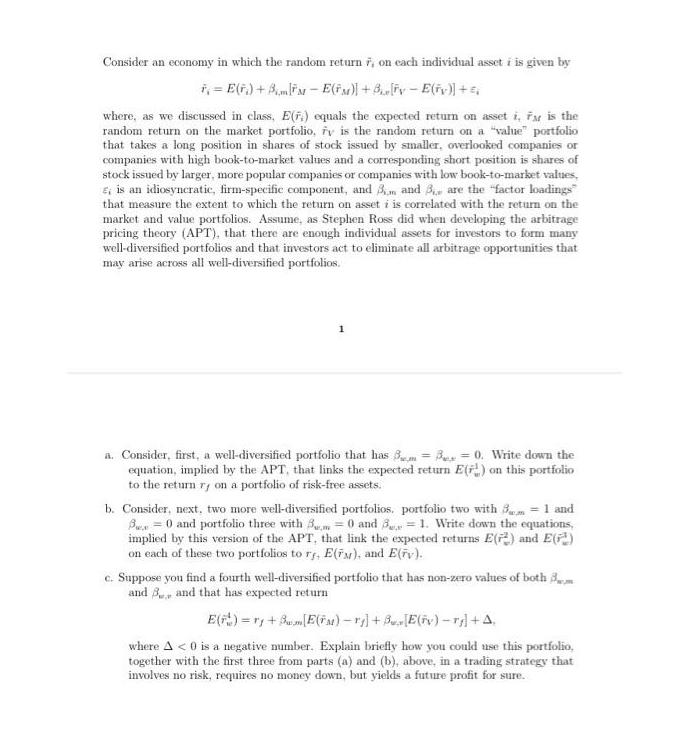
Consider an economy in which the random return, on each individual asset i is given by F = E(F) + Bm-E(FM)]+8F-E(iv)] + where, as we discussed in class, E(F) equals the expected return on asset i, FM is the random return on the market portfolio, y is the random return on a "value" portfolio that takes a long position in shares of stock issued by smaller, overlooked companies or companies with high book-to-market values and a corresponding short position is shares of stock issued by larger, more popular companies or companies with low book-to-market values, E, is an idiosyncratic, firm-specific component, and 3 and 3 are the "factor loadings" that measure the extent to which the return on asset i is correlated with the return on the market and value portfolios. Assume, as Stephen Ross did when developing the arbitrage pricing theory (APT), that there are enough individual assets for investors to form many well-diversified portfolios and that investors act to eliminate all arbitrage opportunities that may arise across all well-diversified portfolios. 1 a. Consider, first, a well-diversified portfolio that has 8 = = 0. Write down the equation, implied by the APT, that links the expected return E(F) on this portfolio to the return ry on a portfolio of risk-free assets. = 1 and b. Consider, next, two more well-diversified portfolios, portfolio two with B = 0 and portfolio three with = 0 and 31. Write down the equations, implied by this version of the APT, that link the expected returns E(2) and E(F) on each of these two portfolios to ry, E(FM), and E(F). c. Suppose you find a fourth well-diversified portfolio that has non-zero values of both m and and that has expected return E()=ry +[E(F) ry] + [E(iv) rg]+A. where A < 0 is a negative number. Explain briefly how you could use this portfolio, together with the first three from parts (a) and (b), above, in a trading strategy that involves no risk, requires no money down, but yields a future profit for sure.
Step by Step Solution
3.37 Rating (156 Votes )
There are 3 Steps involved in it
The Arbitrage Pricing theory is based on the idea that the return on an asset c... View full answer

Get step-by-step solutions from verified subject matter experts