Question: Consider different approaches for managing capacity listed. Give an example of a real-world company that uses each of the approaches. Managing Capacity In managing capacity
- Consider different approaches for managing capacity listed. Give an example of a real-world company that uses each of the approaches.
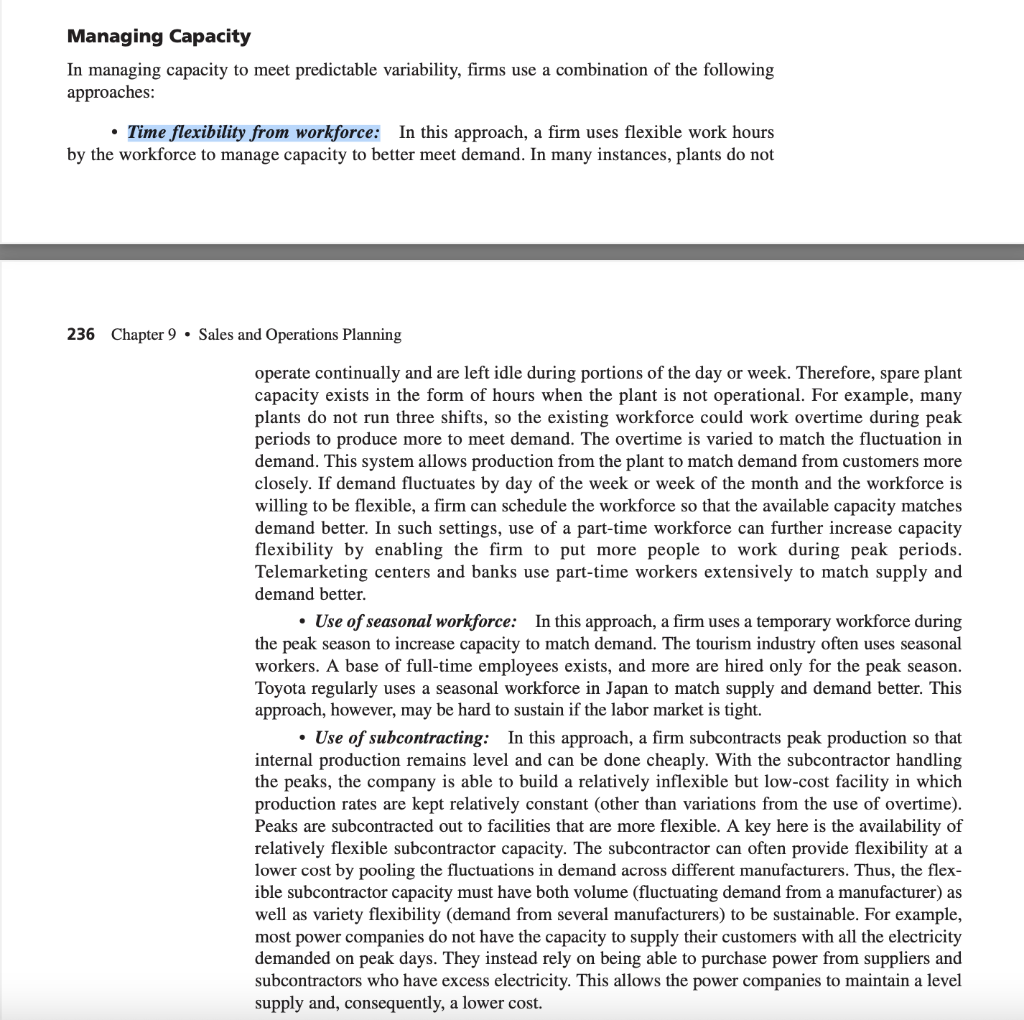
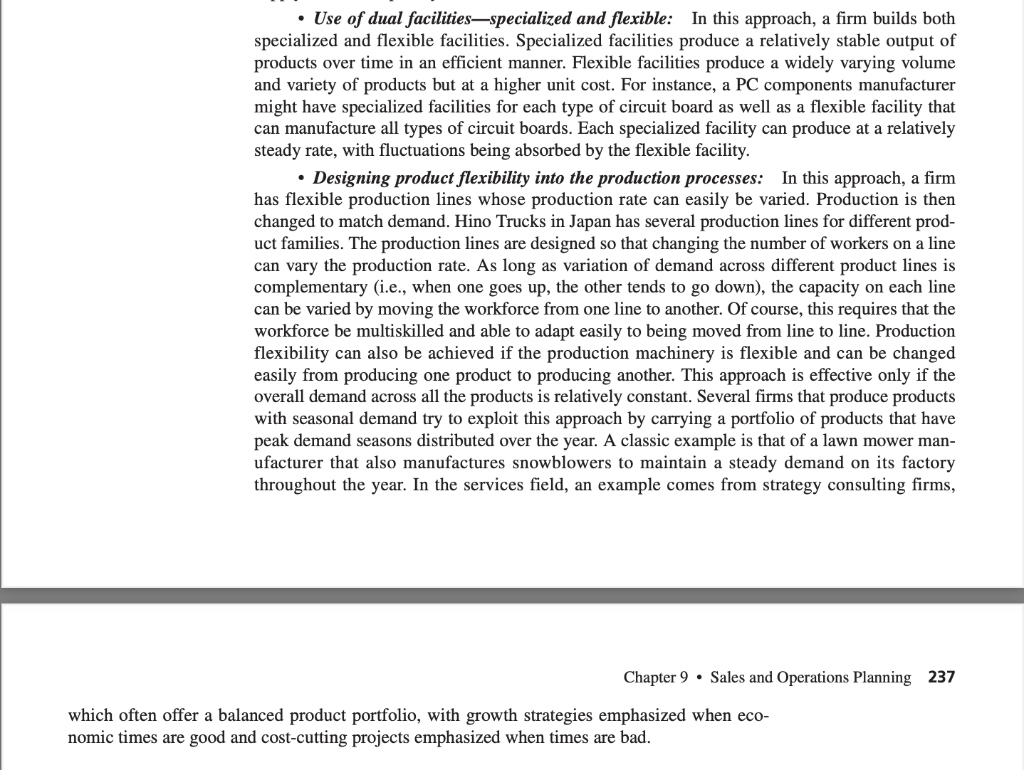
Managing Capacity In managing capacity to meet predictable variability, firms use a combination of the following approaches: Time flexibility from workforce: In this approach, a firm uses flexible work hours by the workforce to manage capacity to better meet demand. In many instances, plants do not 236 Chapter 9 Sales and Operations Planning operate continually and are left idle during portions of the day or week. Therefore, spare plant capacity exists in the form of hours when the plant is not operational. For example, many plants do not run three shifts, so the existing workforce could work overtime during peak periods to produce more to meet demand. The overtime is varied to match the fluctuation in demand. This system allows pro tion from the plant to match demand from customers more closely. If demand fluctuates by day of the week or week of the month and the workforce is willing to be flexible, a firm can schedule the workforce so that the available capacity matches demand better. In such settings, use of a part-time workforce can further increase capacity flexibility by enabling the firm to put more people to work during peak periods. Telemarketing centers and banks use part-time workers extensively to match supply and demand better. Use of seasonal workforce: In this approach, a firm uses a temporary workforce during the peak season to increase capacity to match demand. The tourism industry often uses seasonal workers. A base of full-time employees exists, and more are hired only for the peak season. Toyota regularly uses a seasonal workforce in Japan to match supply and demand better. This approach, however, may be hard to sustain if the labor market is tight. Use of subcontracting: In this approach, a firm subcontracts peak production so that internal production remains level and can be done cheaply. With the subcontractor handling the peaks, the company is able to build a relatively inflexible but low-cost facility in which production rates are kept relatively constant (other than variations from the use of overtime). Peaks are subcontracted out to facilities that are more flexible. A key here is the availability of relatively flexible subcontractor capacity. The subcontractor can often provide flexibility at a lower cost by pooling the fluctuations in demand across different manufacturers. Thus, the flex- ible subcontractor capacity must have both volume (fluctuating demand from a manufacturer) as well as variety flexibility (demand from several manufacturers) to be sustainable. For example, most power companies do not have the capacity to supply their customers with all the electricity demanded on peak days. They instead rely on being able to purchase power from suppliers and subcontractors who have excess electricity. This allows the power companies to maintain a level supply and, consequently, a lower cost. Use of dual facilities specialized and flexible: In this approach, a firm builds both specialized and flexible facilities. Specialized facilities produce a relatively stable output of products over time in an efficient manner. Flexible facilities produce a widely varying volume and variety of products but at a higher unit cost. For instance, a PC components manufacturer might have specialized facilities for each type of circuit board as well as a flexible facility that can manufacture all types of circuit boards. Each specialized facility can produce at a relatively steady rate, with fluctuations being absorbed by the flexible facility. Designing product flexibility into the production processes: In this approach, a firm has flexible production lines whose production rate can easily be varied. Production is then changed to match demand. Hino Trucks in Japan has several production lines for different prod- uct families. The production lines are designed so that changing the number of workers on a line can vary the production rate. As long as variation of demand across different product lines is complementary (i.e., when one goes up, the other tends to go down), the capacity on each line can be varied by moving the workforce from one line to another. Of course, this requires that the workforce be multiskilled and able to adapt easily to being moved from line to line. Production flexibility can also be achieved if the production machinery is flexible and can be changed easily from producing one product to producing another. This approach is effective only if the overall demand across all the products is relatively constant. Several firms that produce products with seasonal demand try to exploit this approach by carrying a portfolio of products that have peak demand seasons distributed over the year. A classic example is that of a lawn mower man- facturer that also manufactures snowblowers to maintain a steady demand on its factory throughout the year. In the services field, an example comes from strategy consulting firms, Chapter 9. Sales and Operations Planning 237 which often offer a balanced product portfolio, with growth strategies emphasized when eco- nomic times are good and cost-cutting projects emphasized when times are bad









 Study Help