







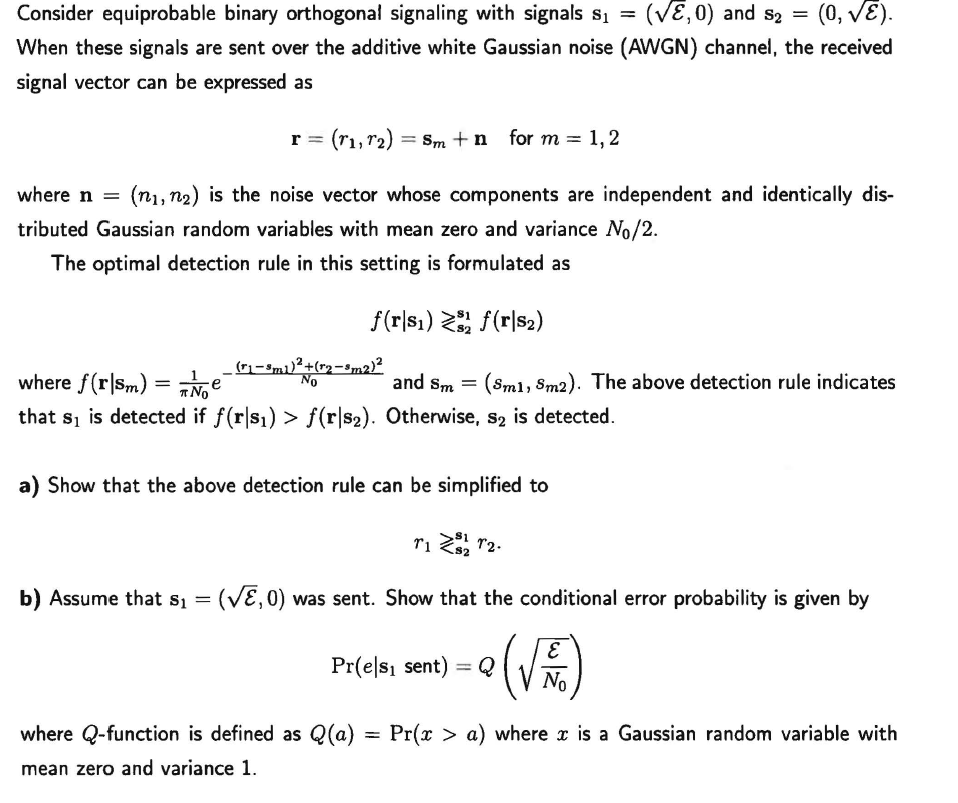
Question: Consider equiprobable binary orthogonal signaling with signals s 1 = ( E 2 , 0 ) and s 2 = ( 0 , E 2
Consider equiprobable binary orthogonal signaling with signals and
When these signals are sent over the additive white Gaussian noise AWGN channel, the received
signal vector can be expressed as
for
where is the noise vector whose components are independent and identically dis
tributed Gaussian random variables with mean zero and variance
The optimal detection rule in this setting is formulated as
where and The above detection rule indicates
that is detected if Otherwise, is detected.
a Show that the above detection rule can be simplified to
b Assume that was sent. Show that the conditional error probability is given by
sent
where function is defined as where is a Gaussian random variable with
mean zero and variance
Step by Step Solution
There are 3 Steps involved in it
1 Expert Approved Answer
Step: 1 Unlock

Question Has Been Solved by an Expert!
Get step-by-step solutions from verified subject matter experts
Step: 2 Unlock
Step: 3 Unlock
 Study Help