







Question: Consider exactly the same setup of question 2, part (e). However, now you care only about the grade. Your grade in ECON7030 is determined by
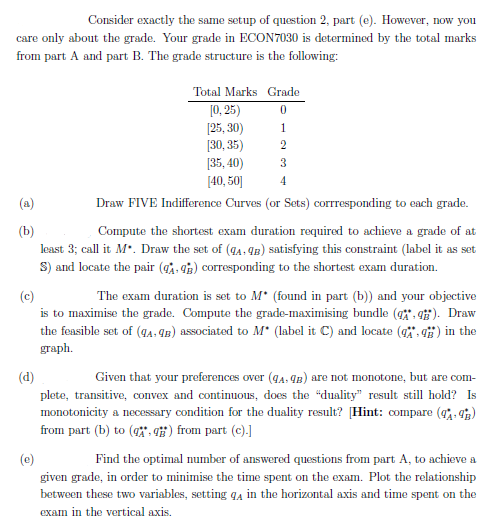
Consider exactly the same setup of question 2, part (e). However, now you care only about the grade. Your grade in ECON7030 is determined by the total marks from part A and part B. The grade structure is the following: Total Marks Grade [0, 25) [25, 30) (30, 35) [35, 40) 3 [40, 50] (a) Draw FIVE Indifference Curves (or Sets) corrresponding to each grade. (b) Compute the shortest exam duration required to achieve a grade of at least 3; call it M. Draw the set of (qA. 98) satisfying this constraint (label it as set S) and locate the pair (qA, q;) corresponding to the shortest exam duration. (c) The exam duration is set to M* (found in part (b)) and your objective is to maximise the grade. Compute the grade-maximising bundle (q) , q; ). Draw the feasible set of (qA, 98) associated to M' (label it C) and locate (q), q# ) in the graph. (d) Given that your preferences over (94, 9g) are not monotone, but are com- plete, transitive, convex and continuous, does the "duality" result still hold? Is monotonicity a necessary condition for the duality result? [Hint: compare (4). 9;) from part (b) to (q), q# ) from part (c).] (e) Find the optimal number of answered questions from part A, to achieve a given grade, in order to minimise the time spent on the exam. Plot the relationship between these two variables, setting qA in the horizontal axis and time spent on the exam in the vertical axis
Step by Step Solution
There are 3 Steps involved in it

Get step-by-step solutions from verified subject matter experts
 Study Help