







Question: Consider list = { 18, 20, 14, 16, 13, 15, 22, 11, 12, 19). Suppose we use the quick sort algorithm to sort list
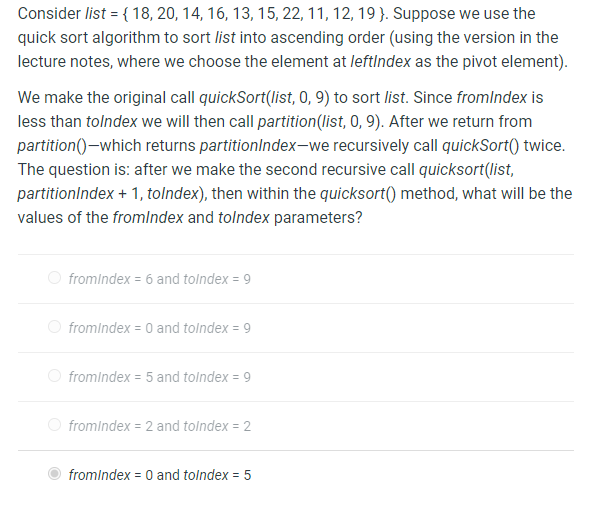
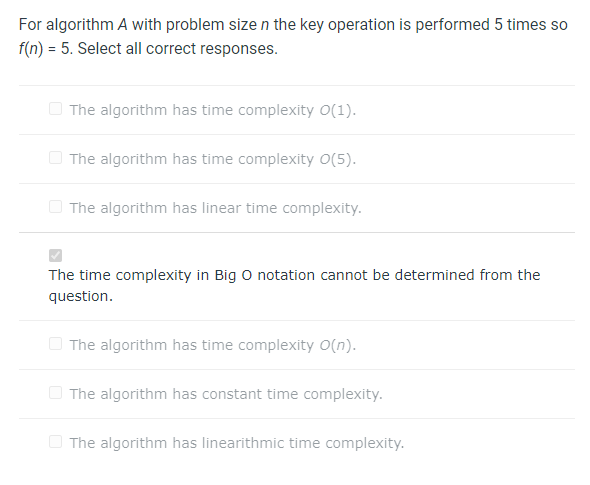
Consider list = { 18, 20, 14, 16, 13, 15, 22, 11, 12, 19). Suppose we use the quick sort algorithm to sort list into ascending order (using the version in the lecture notes, where we choose the element at leftIndex as the pivot element). We make the original call quickSort(list, 0, 9) to sort list. Since fromIndex is less than toIndex we will then call partition (list, 0, 9). After we return from partition ()-which returns partition Index-we recursively call quickSort() twice. The question is: after we make the second recursive call quicksort(list, partitionIndex + 1, toIndex), then within the quicksort() method, what will be the values of the fromIndex and tolndex parameters? O fromIndex = 6 and toIndex = 9 fromIndex = 0 and toIndex = 9 fromIndex = 5 and toIndex = 9 O fromIndex = 2 and toindex = 2 fromIndex = 0 and toIndex = 5 For algorithm A with problem size n the key operation is performed 5 times so f(n) = 5. Select all correct responses. The algorithm has time complexity 0(1). The algorithm has time complexity O(5). The algorithm has linear time complexity. The time complexity in Big O notation cannot be determined from the question. The algorithm has time complexity O(n). The algorithm has constant time complexity. The algorithm has linearithmic time complexity.
Step by Step Solution
There are 3 Steps involved in it
The detailed answer for the above question is provided below 1 Values of fromIndex and toIndex after ... View full answer

Get step-by-step solutions from verified subject matter experts
 Study Help