







Question: Consider the assembly code below it is the same code as in the previous question Suppose that the function is called as follows long result
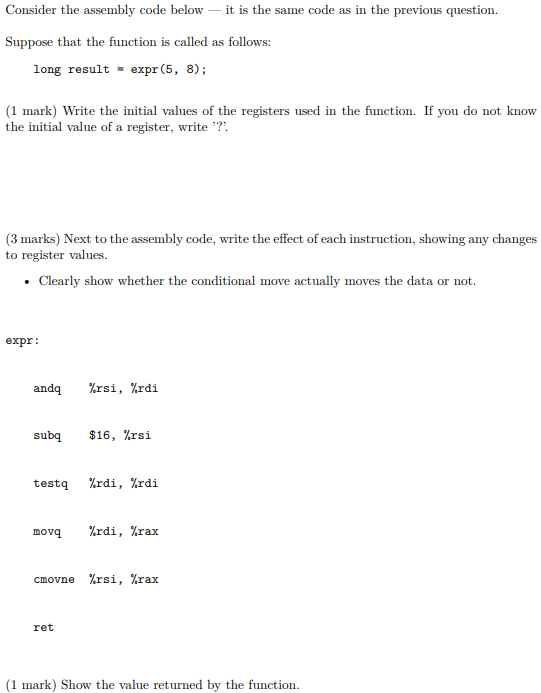
Consider the assembly code below it is the same code as in the previous question Suppose that the function is called as follows long result expr(5, 8); 1 mark) Write the initial values of the registers used in the function. If you do not know the initial value of a register, write? (3 marks) Next to the assembly code, write the effect of each instruction, showing any changes to register values Clearly show whether the conditional move actually moves the data or not. expr: andq %rsi, %rdi subq $16, %rsi testq %rdi , %rdi movq %rdi, %rax ovne %rsi, %rax (1 mark) Show the value returned by the function Consider the assembly code below it is the same code as in the previous question Suppose that the function is called as follows long result expr(5, 8); 1 mark) Write the initial values of the registers used in the function. If you do not know the initial value of a register, write? (3 marks) Next to the assembly code, write the effect of each instruction, showing any changes to register values Clearly show whether the conditional move actually moves the data or not. expr: andq %rsi, %rdi subq $16, %rsi testq %rdi , %rdi movq %rdi, %rax ovne %rsi, %rax (1 mark) Show the value returned by the function
Step by Step Solution
There are 3 Steps involved in it

Get step-by-step solutions from verified subject matter experts
 Study Help