







Question: Consider the basic setup of the Diamond-Dybvig (1983) model. Specifically, there are three periods, denoted t=0,1,2, a single consumption good, and an illiquid investment
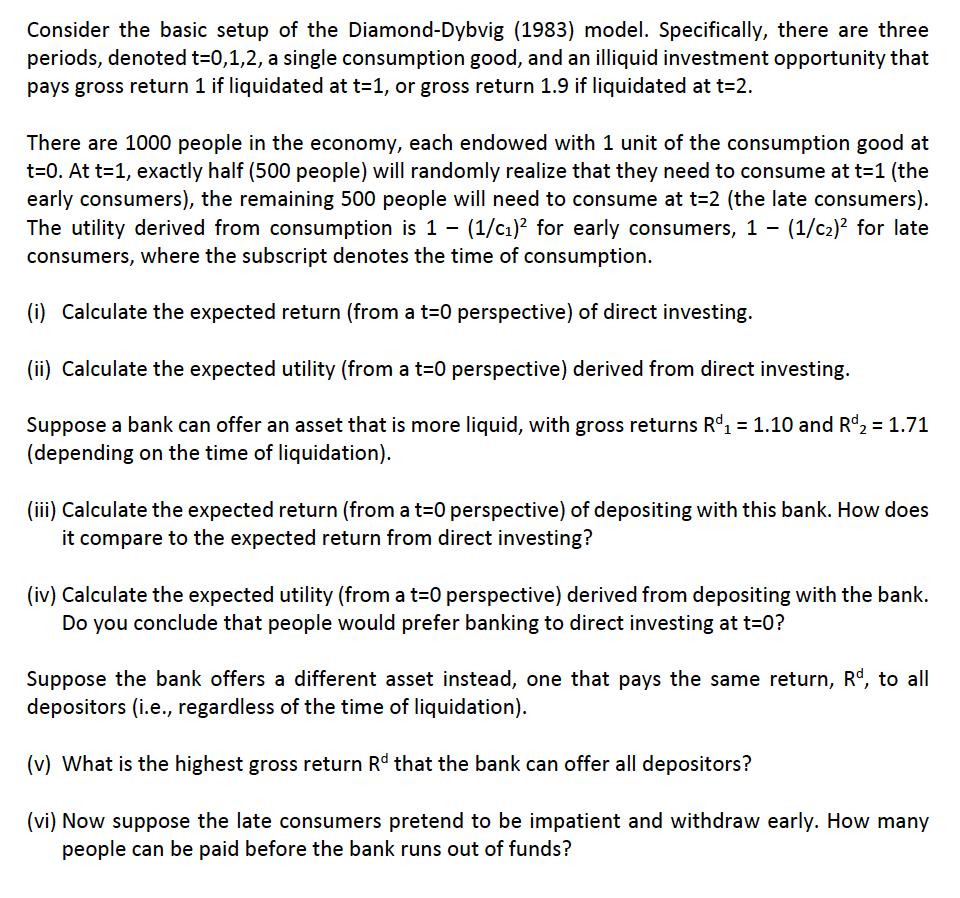
Consider the basic setup of the Diamond-Dybvig (1983) model. Specifically, there are three periods, denoted t=0,1,2, a single consumption good, and an illiquid investment opportunity that pays gross return 1 if liquidated at t=1, or gross return 1.9 if liquidated at t=2. There are 1000 people in the economy, each endowed with 1 unit of the consumption good at t=0. At t=1, exactly half (500 people) will randomly realize that they need to consume at t=1 (the early consumers), the remaining 500 people will need to consume at t=2 (the late consumers). The utility derived from consumption is 1 (1/c) for early consumers, 1 - (1/c) for late consumers, where the subscript denotes the time of consumption. (i) Calculate the expected return (from a t=0 perspective) of direct investing. (ii) Calculate the expected utility (from a t=0 perspective) derived from direct investing. Suppose a bank can offer an asset that is more liquid, with gross returns Rd = 1.10 and Rd = 1.71 (depending on the time of liquidation). (iii) Calculate the expected return (from a t=0 perspective) of depositing with this bank. How does it compare to the expected return from direct investing? (iv) Calculate the expected utility (from a t=0 perspective) derived from depositing with the bank. Do you conclude that people would prefer banking to direct investing at t=0? Suppose the bank offers a different asset instead, one that pays the same return, Rd, to all depositors (i.e., regardless of the time of liquidation). (v) What is the highest gross return Rd that the bank can offer all depositors? (vi) Now suppose the late consumers pretend to be impatient and withdraw early. How many people can be paid before the bank runs out of funds?
Step by Step Solution
3.43 Rating (159 Votes )
There are 3 Steps involved in it
i The expected return of direct investing is 145 1912 as t... View full answer

Get step-by-step solutions from verified subject matter experts
 Study Help