







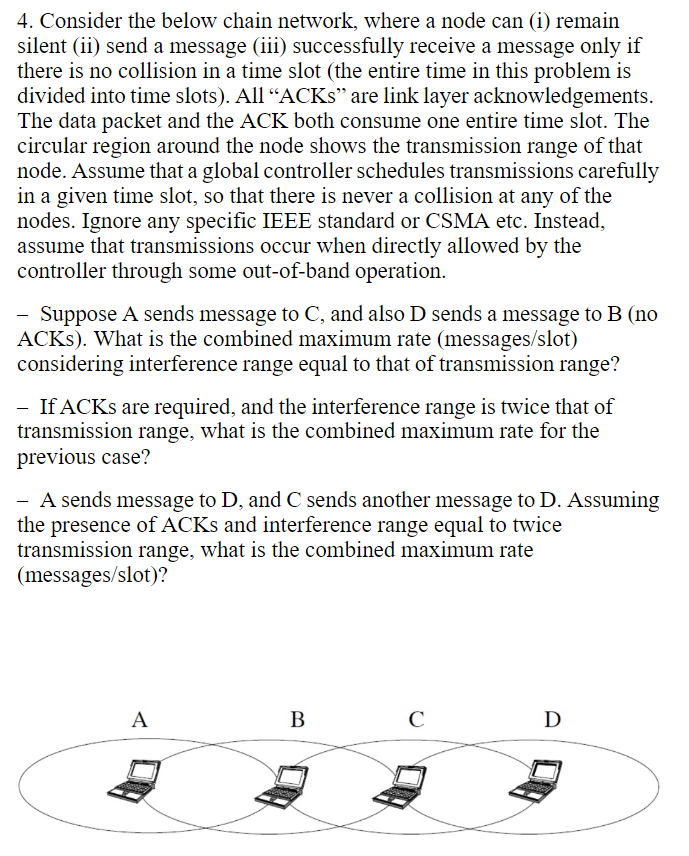
Question: Consider the below chain network, where a node can ( i ) remain silent ( ii ) send a message ( iii ) successfully receive
Consider the below chain network, where a node can i remain
silent ii send a message iii successfully receive a message only if
there is no collision in a time slot the entire time in this problem is
divided into time slots All "ACKs" are link layer acknowledgements.
The data packet and the ACK both consume one entire time slot. The circular region around the node shows the transmission range of that node. Assume that a global controller schedules transmissions carefully in a given time slot, so that there is never a collision at any of the nodes. Ignore any specific IEEE standard or CSMA etc. Instead, assume that transmissions occur when directly allowed by the controller through some outofband operation.
Suppose A sends message to C and also D sends a message to B no
ACKs What is the combined maximum rate messagesslot
considering interference range equal to that of transmission range?
If ACKs are required, and the interference range is twice that of
transmission range, what is the combined maximum rate for the
previous case?
A sends message to D and C sends another message to D Assuming the presence of ACK and interference range equal to twice transmission range, what is the combined maximum rate
messagesslot
Step by Step Solution
There are 3 Steps involved in it
1 Expert Approved Answer
Step: 1 Unlock

Question Has Been Solved by an Expert!
Get step-by-step solutions from verified subject matter experts
Step: 2 Unlock
Step: 3 Unlock
 Study Help