







Question: Consider the below decision tree The numbers (in $millions) without parentheses next to each arc identify a payment (if negative) or a revenue (if
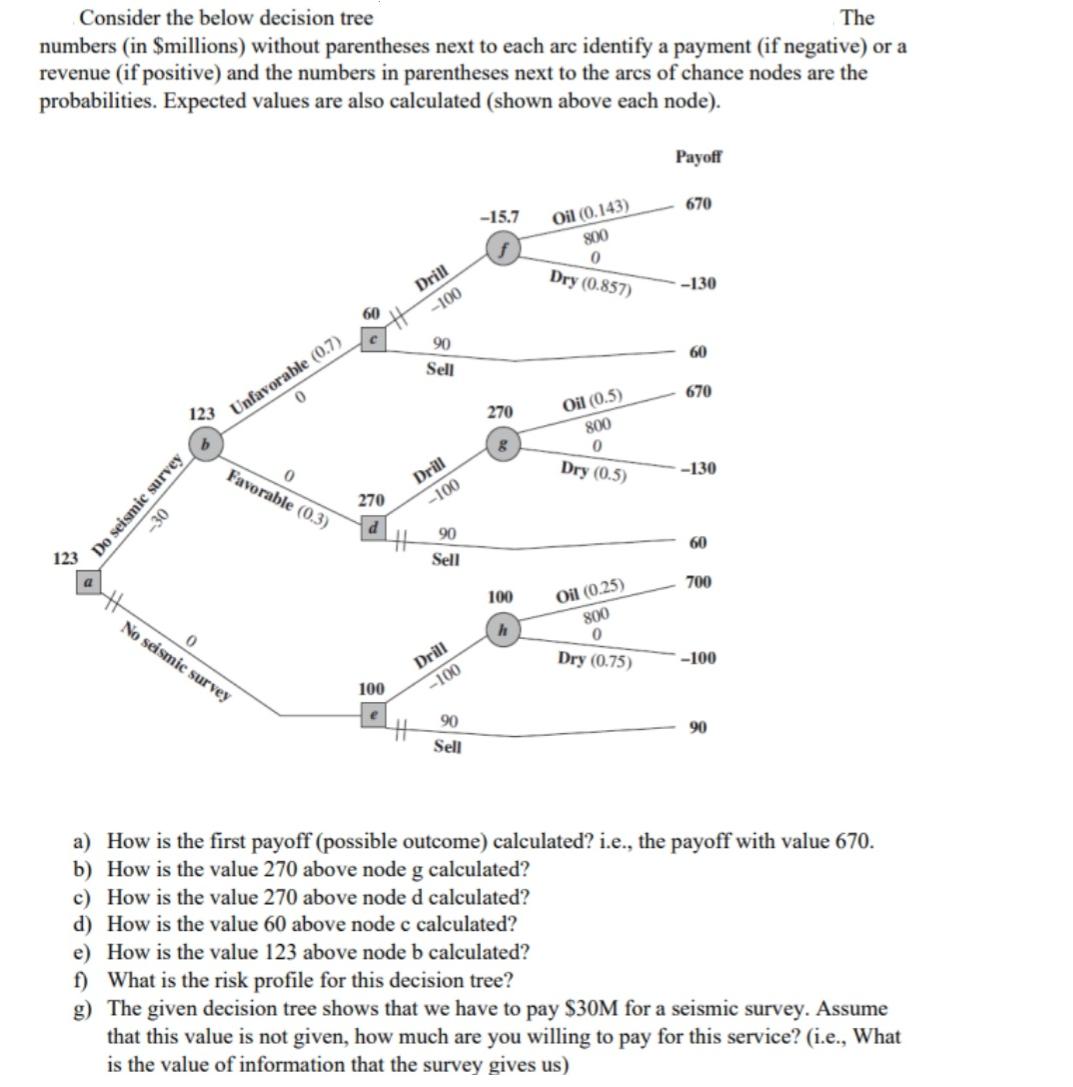
Consider the below decision tree The numbers (in $millions) without parentheses next to each arc identify a payment (if negative) or a revenue (if positive) and the numbers in parentheses next to the arcs of chance nodes are the probabilities. Expected values are also calculated (shown above each node). 123 a 123 6 -30 Do seismic survey Unfavorable (0.7) Favorable (0.3) 0 No seismic survey 60 270 d 100 Drill -100 90 Sell Drill -100 90 Sell Drill -100 90 Sell -15.7 270 8 100 h Oil (0.143) 800 0 Dry (0.857) c) How is the value 270 above node d calculated? d) How is the value 60 above node c calculated? Oil (0.5) 800 0 Dry (0.5) Oil (0.25) 800 0 Dry (0.75) Payoff 670 -130 60 670 -130 60 700 -100 90 a) How is the first payoff (possible outcome) calculated? i.e., the payoff with value 670. b) How is the value 270 above node g calculated? e) How is the value 123 above node b calculated? f) What is the risk profile for this decision tree? g) The given decision tree shows that we have to pay $30M for a seismic survey. Assume that this value is not given, how much are you willing to pay for this service? (i.e., What is the value of information that the survey gives us)
Step by Step Solution
3.50 Rating (173 Votes )
There are 3 Steps involved in it
Step1 To answer your questions about the decision tree lets go through each one Explanation a The first payoff with a value of 670 is calculated by multiplying the probability of reaching that outcome ... View full answer

Get step-by-step solutions from verified subject matter experts
 Study Help