







Question: Consider the bivariate function f(x, y) = 10x + 5y - 2xy - 8x-2y+4, for x, y = R. Figures 2 and 3 show
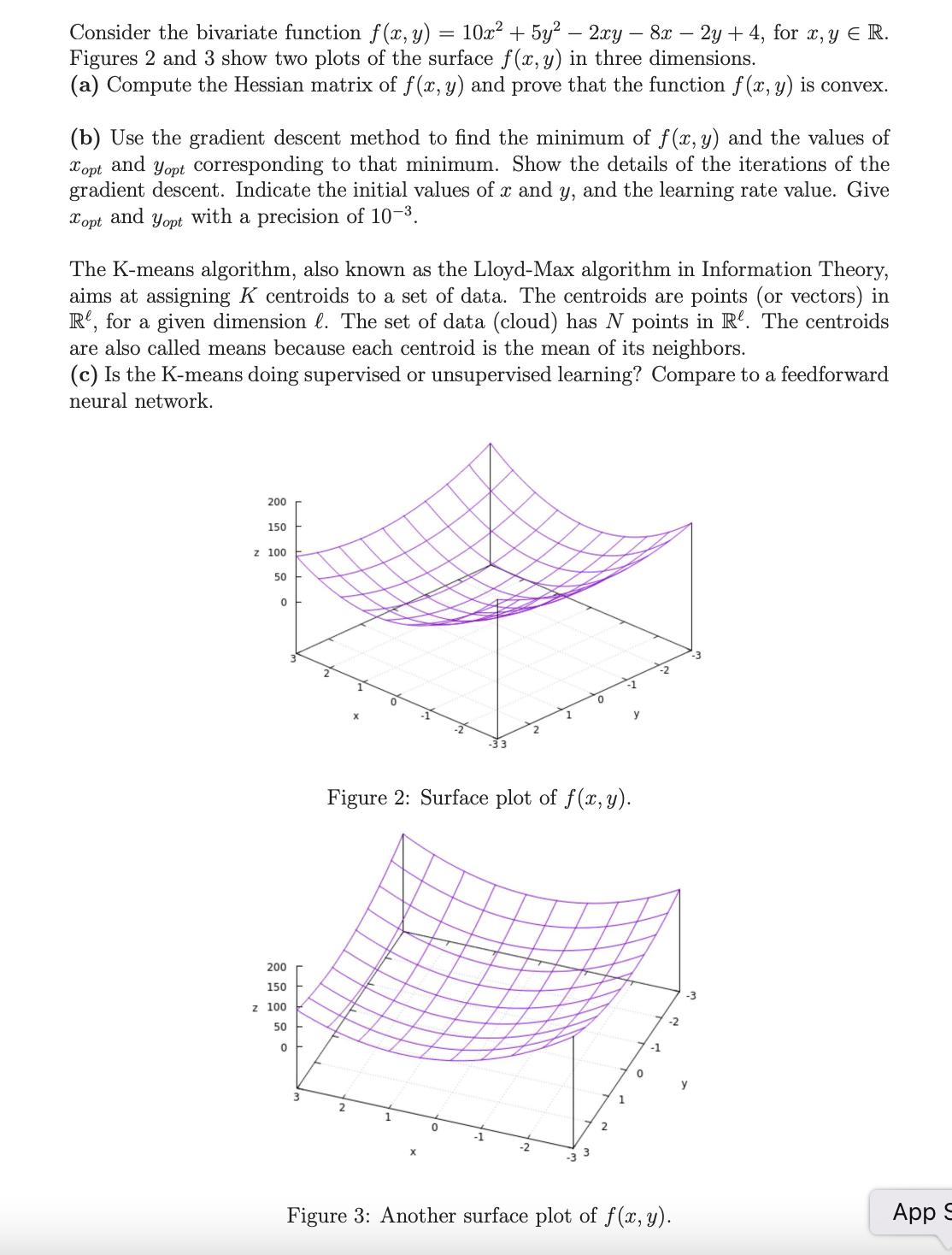
Consider the bivariate function f(x, y) = 10x + 5y - 2xy - 8x-2y+4, for x, y = R. Figures 2 and 3 show two plots of the surface f(x, y) in three dimensions. (a) Compute the Hessian matrix of f(x, y) and prove that the function f(x, y) is convex. (b) Use the gradient descent method to find the minimum of f(x, y) and the values of xopt and Yopt corresponding to that minimum. Show the details of the iterations of the gradient descent. Indicate the initial values of x and y, and the learning rate value. Give xopt and Yopt with a precision of 10-. The K-means algorithm, also known as the Lloyd-Max algorithm in Information Theory, aims at assigning K centroids to a set of data. The centroids are points (or vectors) in Re, for a given dimension l. The set of data (cloud) has N points in Re. The centroids are also called means because each centroid is the mean of its neighbors. (c) Is the K-means doing supervised or unsupervised learning? Compare to a feedforward neural network. 200 150 z 100 50 0 200 150 z 100 50 0 Figure 2: Surface plot of f(x, y). 3 2 1 0 -2 3 x 2 1 -2 Figure 3: Another surface plot of f(x, y). App S
Step by Step Solution
There are 3 Steps involved in it

Get step-by-step solutions from verified subject matter experts
 Study Help