







Question: Consider the C program in UNIX/LINUX environment provided below. Consider that the system calls do not fail, function gn () never returns, function gn() does
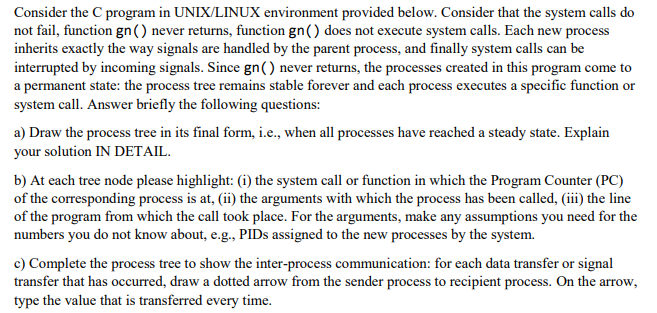
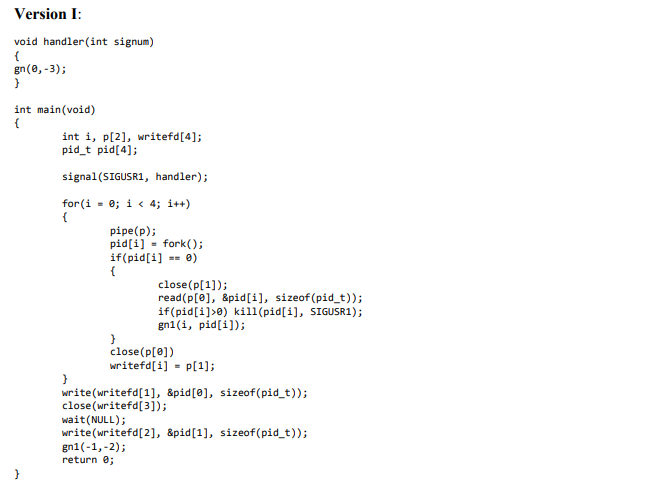
Consider the C program in UNIX/LINUX environment provided below. Consider that the system calls do not fail, function gn () never returns, function gn() does not execute system calls. Each new process inherits exactly the way signals are handled by the parent process, and finally system calls can be interrupted by incoming signals. Since gn() never returns, the processes created in this program come to a permanent state: the process tree remains stable forever and each process executes a specific function or system call. Answer briefly the following questions: a) Draw the process tree in its final form, i.e., when all processes have reached a steady state. Explain your solution IN D b) At each tree node please highlight:() the system call or function in which the Program Counter (PC) of the corresponding process is at, (ii) the arguments with which the process has been called, (ii) the line of the program from which the call took place. For the arguments, make any assumptions you need for the numbers you do not know about, e.g., PIDs assigned to the new processes by the system. c) Complete the process tree to show the inter-process communication: for each data transfer or signal transfer that has occurred, draw a dotted arrow from the sender process to recipient process. On the arrow, type the value that is transferred every time. Consider the C program in UNIX/LINUX environment provided below. Consider that the system calls do not fail, function gn () never returns, function gn() does not execute system calls. Each new process inherits exactly the way signals are handled by the parent process, and finally system calls can be interrupted by incoming signals. Since gn() never returns, the processes created in this program come to a permanent state: the process tree remains stable forever and each process executes a specific function or system call. Answer briefly the following questions: a) Draw the process tree in its final form, i.e., when all processes have reached a steady state. Explain your solution IN D b) At each tree node please highlight:() the system call or function in which the Program Counter (PC) of the corresponding process is at, (ii) the arguments with which the process has been called, (ii) the line of the program from which the call took place. For the arguments, make any assumptions you need for the numbers you do not know about, e.g., PIDs assigned to the new processes by the system. c) Complete the process tree to show the inter-process communication: for each data transfer or signal transfer that has occurred, draw a dotted arrow from the sender process to recipient process. On the arrow, type the value that is transferred every time
Step by Step Solution
There are 3 Steps involved in it

Get step-by-step solutions from verified subject matter experts
 Study Help