







Question: = Consider the catalyzed polymerization between a diol AA and a dicarboxylic acid BB. Assume that the concentration of the catalyst is constant. a) What
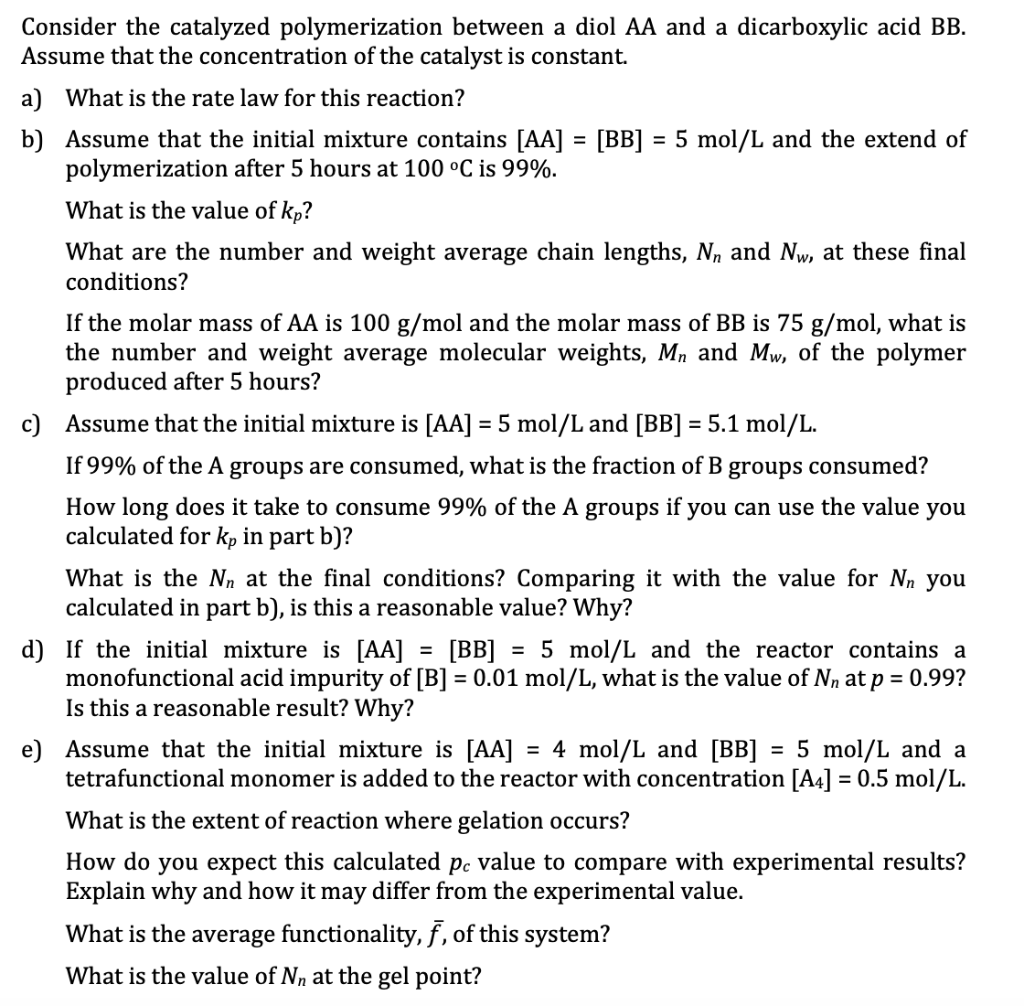
= Consider the catalyzed polymerization between a diol AA and a dicarboxylic acid BB. Assume that the concentration of the catalyst is constant. a) What is the rate law for this reaction? b) Assume that the initial mixture contains [AA] [BB] = 5 mol/L and the extend of polymerization after 5 hours at 100 C is 99%. What is the value of kp? What are the number and weight average chain lengths, Nn and Nw, at these final conditions? If the molar mass of AA is 100 g/mol and the molar mass of BB is 75 g/mol, what is the number and weight average molecular weights, Mn and Mw, of the polymer produced after 5 hours? c) Assume that the initial mixture is [AA] = 5 mol/L and [BB] = 5.1 mol/L. If 99% of the A groups are consumed, what is the fraction of B groups consumed? How long does it take to consume 99% of the A groups if you can use the value you calculated for kp in part b)? What is the Nn at the final conditions? Comparing it with the value for Nn you calculated in part b), is this a reasonable value? Why? d) If the initial mixture is [AA] [BB] 5 mol/L and the reactor contains a monofunctional acid impurity of [B] = 0.01 mol/L, what is the value of Nn at p = 0.99? Is this a reasonable result? Why? e) Assume that the initial mixture is [AA] 4 mol/L and [BB] = 5 mol/L and a tetrafunctional monomer is added to the reactor with concentration [A4] = 0.5 mol/L. What is the extent of reaction where gelation occurs? How do you expect this calculated pc value to compare with experimental results? Explain why and how it may differ from the experimental value. What is the average functionality, F, of this system? What is the value of Nn at the gel point? = = = = = = Consider the catalyzed polymerization between a diol AA and a dicarboxylic acid BB. Assume that the concentration of the catalyst is constant. a) What is the rate law for this reaction? b) Assume that the initial mixture contains [AA] [BB] = 5 mol/L and the extend of polymerization after 5 hours at 100 C is 99%. What is the value of kp? What are the number and weight average chain lengths, Nn and Nw, at these final conditions? If the molar mass of AA is 100 g/mol and the molar mass of BB is 75 g/mol, what is the number and weight average molecular weights, Mn and Mw, of the polymer produced after 5 hours? c) Assume that the initial mixture is [AA] = 5 mol/L and [BB] = 5.1 mol/L. If 99% of the A groups are consumed, what is the fraction of B groups consumed? How long does it take to consume 99% of the A groups if you can use the value you calculated for kp in part b)? What is the Nn at the final conditions? Comparing it with the value for Nn you calculated in part b), is this a reasonable value? Why? d) If the initial mixture is [AA] [BB] 5 mol/L and the reactor contains a monofunctional acid impurity of [B] = 0.01 mol/L, what is the value of Nn at p = 0.99? Is this a reasonable result? Why? e) Assume that the initial mixture is [AA] 4 mol/L and [BB] = 5 mol/L and a tetrafunctional monomer is added to the reactor with concentration [A4] = 0.5 mol/L. What is the extent of reaction where gelation occurs? How do you expect this calculated pc value to compare with experimental results? Explain why and how it may differ from the experimental value. What is the average functionality, F, of this system? What is the value of Nn at the gel point? = = = = =
Step by Step Solution
There are 3 Steps involved in it

Get step-by-step solutions from verified subject matter experts
 Study Help