







Question: Consider the data. X; 6 9 13 20 y; 7 16 10 27 22 The estimated regression equation for these data is y = 7.4

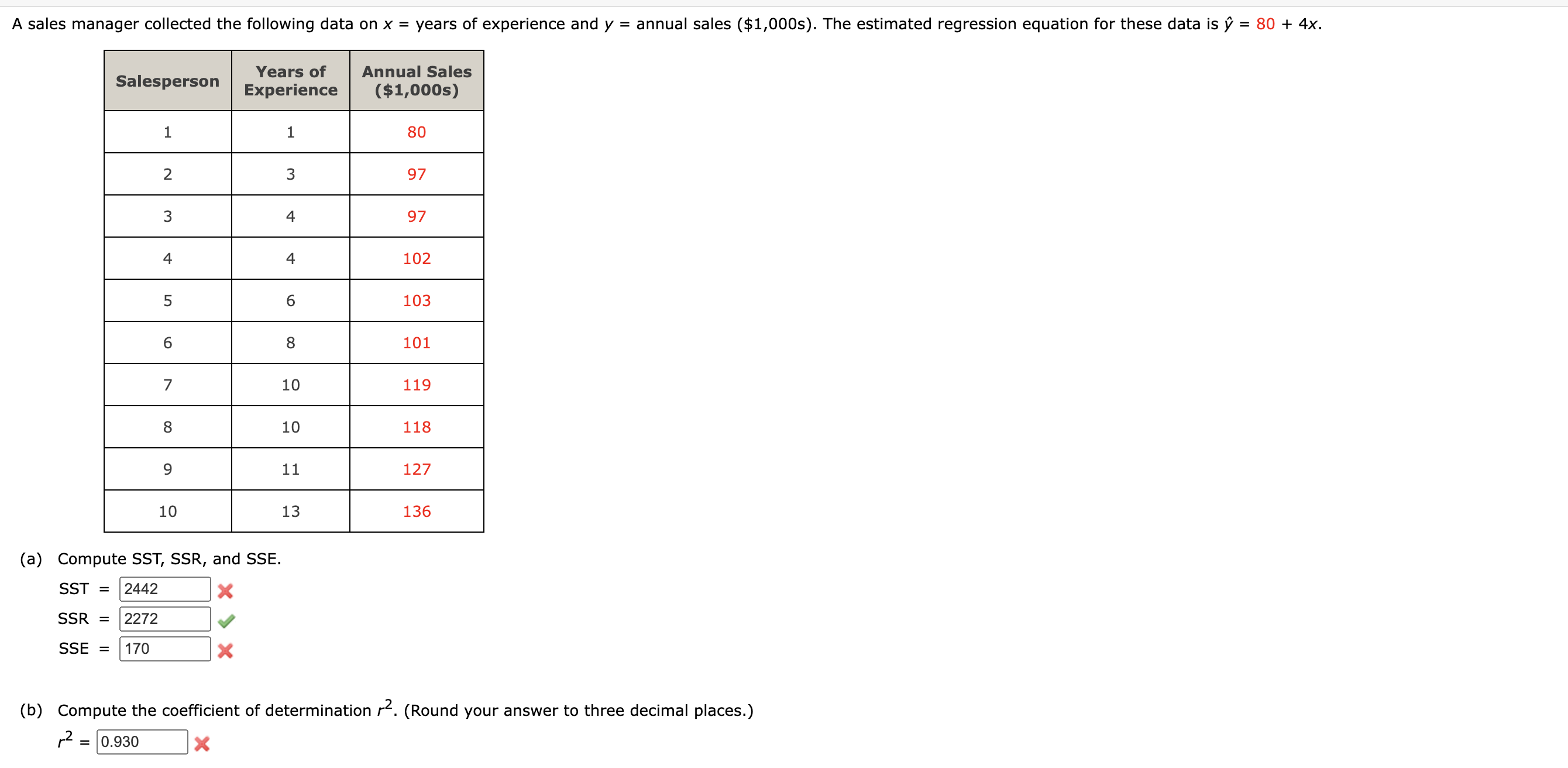

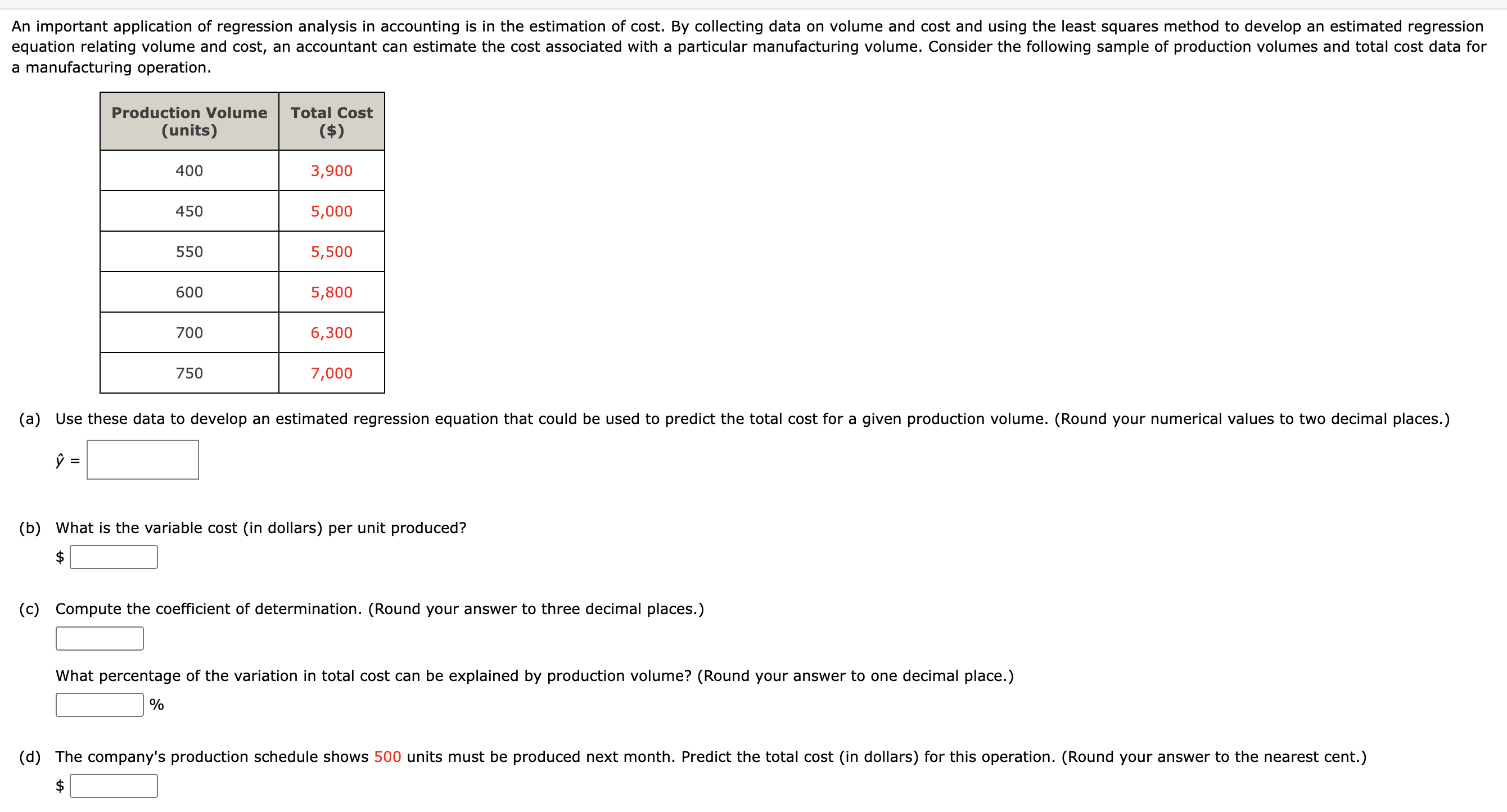
Consider the data. X; 6 9 13 20 y; 7 16 10 27 22 The estimated regression equation for these data is y = 7.4 + 0.9x. What percentage of the total sum of squares can be accounted for by the estimated regression equation? (Round your answer to one decimal place.) What is the value of the coefficient of determination? (Round your answer to three decimal places.)A sales manager collected the following data on x = years of experience and y = annual sales ($1,000s). The estimated regression equation for these data is y = 80 + 4x. Salesperson Years of Annual Sales Experience ($1,000s) 80 2 3 97 3 4 97 A 4 102 6 103 6 8 101 10 119 8 10 118 9 11 127 10 13 136 (a) Compute SST, SSR, and SSE. SST = 2442 X SSR = 2272 SSE = 170 X (b) Compute the coefficient of determination 2. (Round your answer to three decimal places. ) 12 = 0.930 X(c) What is the value of the sample correlation coefficient? (Round your answer to three decimal places.) 0.964 x An important application of regression analysis in accounting is in the estimation of cost. By collecting data on volume and cost and using the least squares method to develop an estimated regression equation relating volume and cost, an accountant can estimate the cost associated with a particular manufacturing volume. Consider the following sample of production volumes and total cost data for a manufacturing operation. Productlon Volume Total Cost (unite) ($) 400 3,900 450 5,000 550 5,500 600 5,800 700 6,300 750 7,000 (a) Use these data to develop an estimated regression equation that could be used to predict the total cost for a given production volume. (Round your numerical values to two decimal places.) y: (b) What is the variable cost (in dollars) per unit produced? $:l (c) Compute the coefficient of determination. (Round your answer to three decimal places.) What percentage of the variation in total cost can be explained by production volume? (Round your answer to one decimal place.) % (d) The company's production schedule shows 500 units must be produced next month. Predict the total cost (in dollars) for this operation. (Round your answer to the nearest cent.) $
Step by Step Solution
There are 3 Steps involved in it

Get step-by-step solutions from verified subject matter experts
 Study Help