







Question: Consider the (directed) network in the attached `network.pdf. We could represent this network with the following Prolog statements: link(a,b). link(a,c). link(b,c). link(b,d). link(c,d). link(d,e). link(d,f).
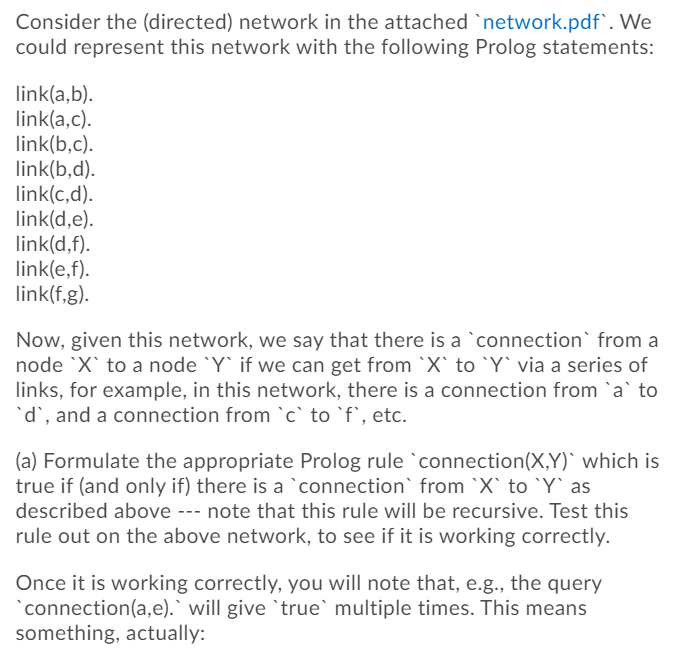
Consider the (directed) network in the attached `network.pdf. We could represent this network with the following Prolog statements: link(a,b). link(a,c). link(b,c). link(b,d). link(c,d). link(d,e). link(d,f). link(e,t). link(f,g). Now, given this network, we say that there is a connection from a node 'X' to a node Y if we can get from 'X' to Y via a series of links, for example, in this network, there is a connection from 'a' to d', and a connection from 'c' to 'f , etc. (a) Formulate the appropriate Prolog rule 'connection(X,Y) which is true if (and only if) there is a connection from 'X' to Y as described above --- note that this rule will be recursive. Test this rule out on the above network, to see if it is working correctly. Once it is working correctly, you will note that, e.g., the query 'connection(a,e).' will give 'true' multiple times. This means something, actually
Step by Step Solution
There are 3 Steps involved in it

Get step-by-step solutions from verified subject matter experts
 Study Help