







Question: Consider the effect of collusion between bidders in a second- price, sealed- bid auction. There is one seller who will sell one object using
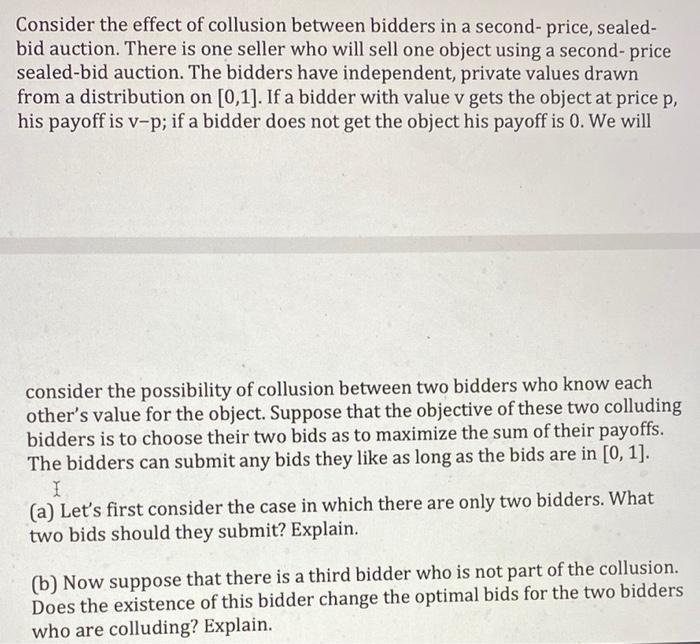
Consider the effect of collusion between bidders in a second- price, sealed- bid auction. There is one seller who will sell one object using a second-price sealed-bid auction. The bidders have independent, private values drawn from a distribution on [0,1]. If a bidder with value v gets the object at price p, his payoff is v-p; if a bidder does not get the object his payoff is 0. We will consider the possibility of collusion between two bidders who know each other's value for the object. Suppose that the objective of these two colluding bidders is to choose their two bids as to maximize the sum of their payoffs. The bidders can submit any bids they like as long as the bids are in [0, 1]. I (a) Let's first consider the case in which there are only two bidders. What two bids should they submit? Explain. (b) Now suppose that there is a third bidder who is not part of the collusion. Does the existence of this bidder change the optimal bids for the two bidders who are colluding? Explain.
Step by Step Solution
There are 3 Steps involved in it
a In a second price sealedbid auction the highest bidder wins the object but pays the price of the s... View full answer

Get step-by-step solutions from verified subject matter experts
 Study Help