







Question: Consider the following algorithm for determining x^(n) for non-negative n . func pow(x,n): result =1 do n times: result **=x return result A.
Consider the following algorithm for determining
x^(n)for non-negative
n.\
func pow(x,n):\ result =1\ do n times: \ result **=x\ return result \ A. Provide pseudocode for a recursive implementation of the above algorithm.\ B. How many multiplications does this algorithm perform? Justify your answer.\ C. Provide pseudocode for a recursive algorithm that computes
x^(n)with
O(logn)multiplications.\ D. Provide pseudocode for an iterative version of the
O(logn)algorithm.
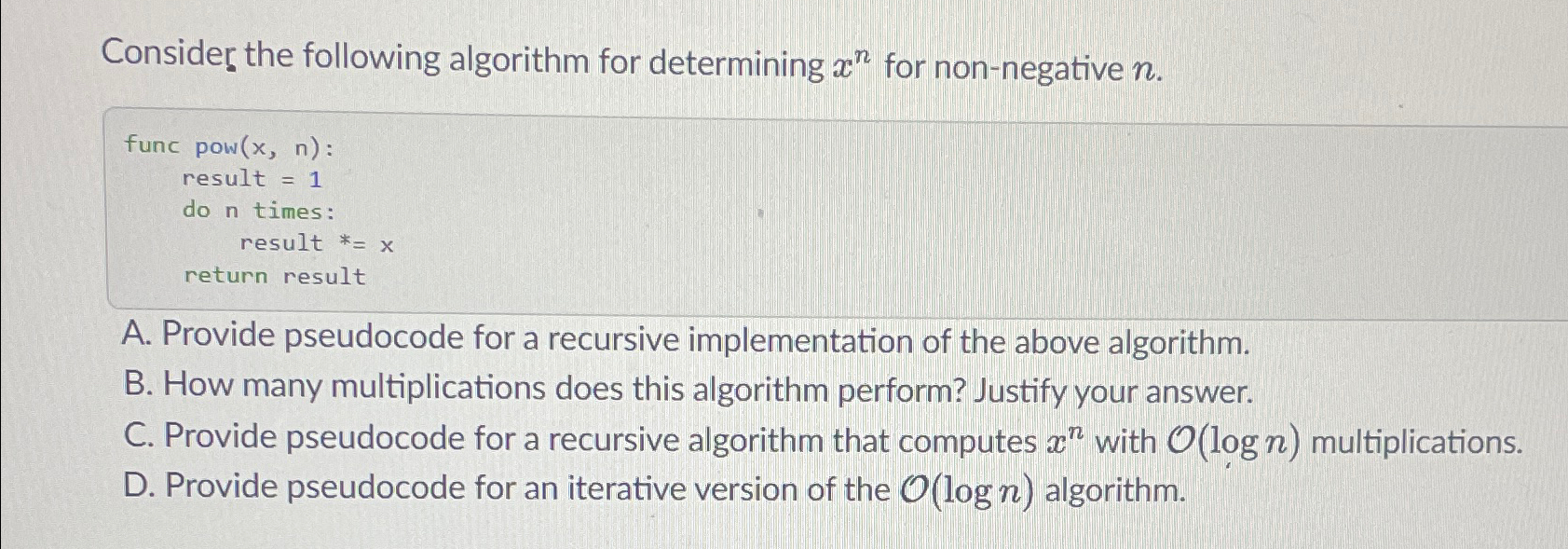
Consider the following algorithm for determining xn for non-negative n. func pow(x,n) : result =1 do n times: result =x return result A. Provide pseudocode for a recursive implementation of the above algorithm. B. How many multiplications does this algorithm perform? Justify your answer. C. Provide pseudocode for a recursive algorithm that computes xn with O(logn) multiplications. D. Provide pseudocode for an iterative version of the O(logn) algorithm. Consider the following algorithm for determining xn for non-negative n. func pow(x,n) : result =1 do n times: result =x return result A. Provide pseudocode for a recursive implementation of the above algorithm. B. How many multiplications does this algorithm perform? Justify your answer. C. Provide pseudocode for a recursive algorithm that computes xn with O(logn) multiplications. D. Provide pseudocode for an iterative version of the O(logn) algorithm
Step by Step Solution
There are 3 Steps involved in it

Get step-by-step solutions from verified subject matter experts
 Study Help