







Question: Consider the following C code segment: int my_global = 0; main (){int x = 10; int y = 20; int z = 0; z =
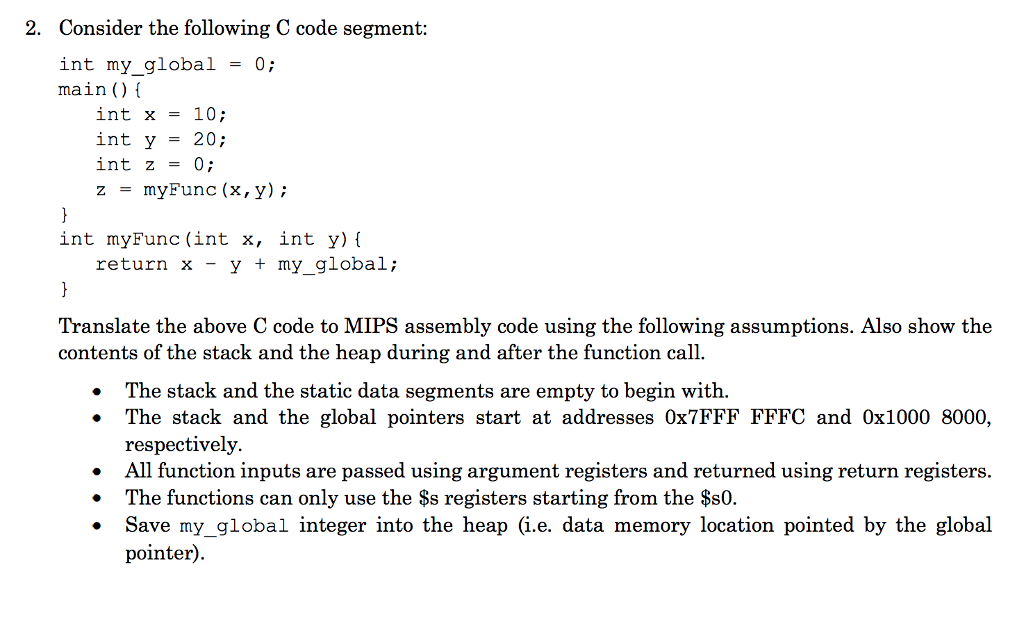
Consider the following C code segment: int my_global = 0; main (){int x = 10; int y = 20; int z = 0; z = myFunc(x, y);} int myFunc(int x, int y) {return x - y + my_global;} Translate the above C code to MIPS assembly code using the following assumptions. Also show the contents of the stack and the heap during and after the function call. The stack and the static data segments are empty to begin with. The stack and the global pointers start at addresses 0x7FFF FFFC and 0x1000 8000, respectively. All function inputs are passed using argument registers and returned using return registers. The functions can only use the $s registers starting from the $s0. Save my_global integer into the heap (i.e. data memory location pointed by the global pointer). Consider the following C code segment: int my_global = 0; main (){int x = 10; int y = 20; int z = 0; z = myFunc(x, y);} int myFunc(int x, int y) {return x - y + my_global;} Translate the above C code to MIPS assembly code using the following assumptions. Also show the contents of the stack and the heap during and after the function call. The stack and the static data segments are empty to begin with. The stack and the global pointers start at addresses 0x7FFF FFFC and 0x1000 8000, respectively. All function inputs are passed using argument registers and returned using return registers. The functions can only use the $s registers starting from the $s0. Save my_global integer into the heap (i.e. data memory location pointed by the global pointer)
Step by Step Solution
There are 3 Steps involved in it

Get step-by-step solutions from verified subject matter experts
 Study Help