







Question: Assume that the stack and the static data segments are empty and that the stack and global pointers start at address 0x7fff fffc and 0x1000
Assume that the stack and the static data segments are empty and that the stack and global pointers start at address 0x7fff fffc and 0x1000 8000, respectively. Assume the calling conventions as speciied in Figure 2.11 and that function inputs are passed using registers $a0–$a3 and returned in register $r0. Assume that leaf functions may only use saved registers.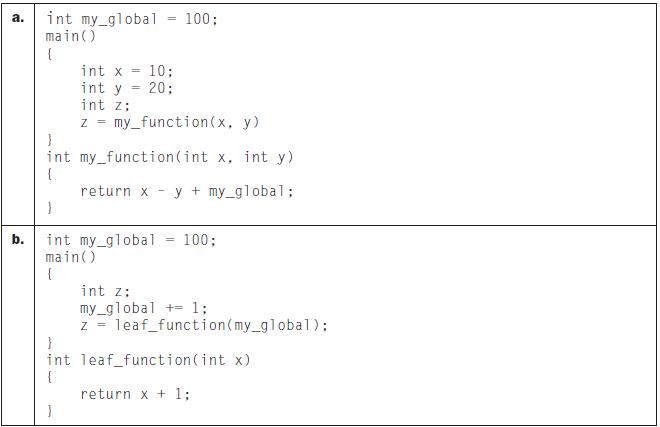
Figure 2.11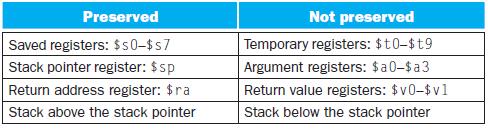
Show the contents of the stack and the static data segments after each function call.
b. int my_global 100; main() { } int { int x = 10; 20: } int y int z; z } int { } int my_global = 100; main () { my_function(x, y). my function(int x, int y) return x y + my_global; int z: my_global += 1; z = leaf_function(my_global); leaf_function(int x) return x + 1;
Step by Step Solution
3.47 Rating (160 Votes )
There are 3 Steps involved in it
The images provided describe two different scenarios each with a code snippet and a listing of register categories as per their usage in functions in what appears to be a MIPSlike assembly language en... View full answer

Get step-by-step solutions from verified subject matter experts
 Study Help