







Question: Consider the following C++ program. #include using namespace std; int fun(int &x, int y) { X=X+1; y=y-1; return y; } int main() { int
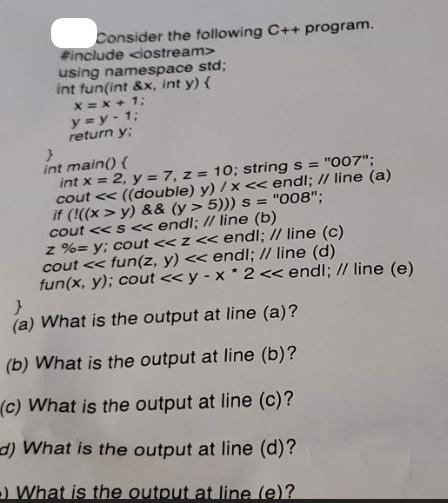
Consider the following C++ program. #include using namespace std; int fun(int &x, int y) { X=X+1; y=y-1; return y; } int main() { int x = 2, y = 7, z = 10; string s = "007"; cout < < ((double) y) / x < < endl; // line (a) if (!((x > y) && (y> 5))) s = "008"; cout < < s < < < endl; // line (b) z %= y; cout < < Z < < endl; // line (c) cout < < < fun(z, y) < < endl; // line (d) fun(x, y); cout < Consider the following C++ program. #include using namespace std; int fun(int &x, int y){ X=X+1; y=y-1; return y; } int main() { int x = 2, y = 7, z = 10; string s = "007"; cout < < ((double) y) / x < < endl; // line (a) if (!((x > y) && (y> 5))) s = "008"; cout < < s < < < endl; // line (b) z %= y; cout
Step by Step Solution
There are 3 Steps involved in it
The output for the required lines would be as follows 2 L... View full answer

Get step-by-step solutions from verified subject matter experts
 Study Help