





Question: Consider the following C program that uses the POSIX API: 'A'; #include #include char valuel = int main() { char value2 = 'A'; pid_t p
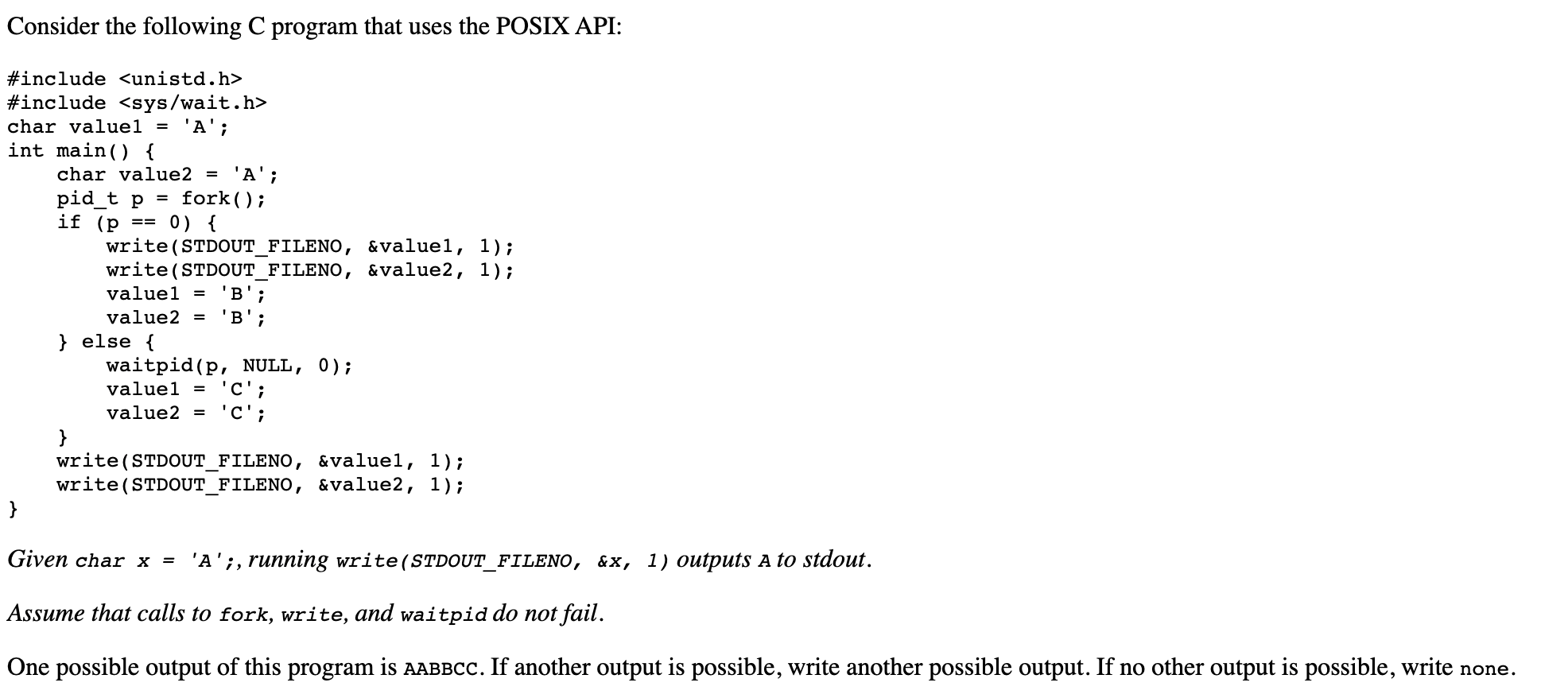
 Consider the following C program that uses the POSIX API: 'A';

Consider the following C program that uses the POSIX API: 'A'; #include #include char valuel = int main() { char value2 = 'A'; pid_t p = fork(); if (p == 0) { write (STDOUT_FILENO, &valuel, 1); write (STDOUT_FILENO, &value2, 1); valuel = value2 = } else { waitpid(p, NULL, 0); valuel = 'C'; value2 = } write (STDOUT_FILENO, &valuel, 1); write(STDOUT_FILENO, &value2, 1); } 'B'; 'B'; 'C'; Given char x 'A';, running write (STDOUT_FILENO, &x, 1) outputs A to stdout. Assume that calls to fork, write, and waitpid do not fail. One possible output of this program is AABBCC. If another output is possible, write another possible output. If no other output is possible, write none

Step by Step Solution

There are 3 Steps involved in it

1 Expert Approved Answer
Step: 1 Unlock blur-text-image
Question Has Been Solved by an Expert!

Get step-by-step solutions from verified subject matter experts

Step: 2 Unlock
Step: 3 Unlock

Students Have Also Explored These Related Databases Questions!