







Question: Consider the following class definitions: class A: def ( self , par = 2 : print ( / b a r ( A )
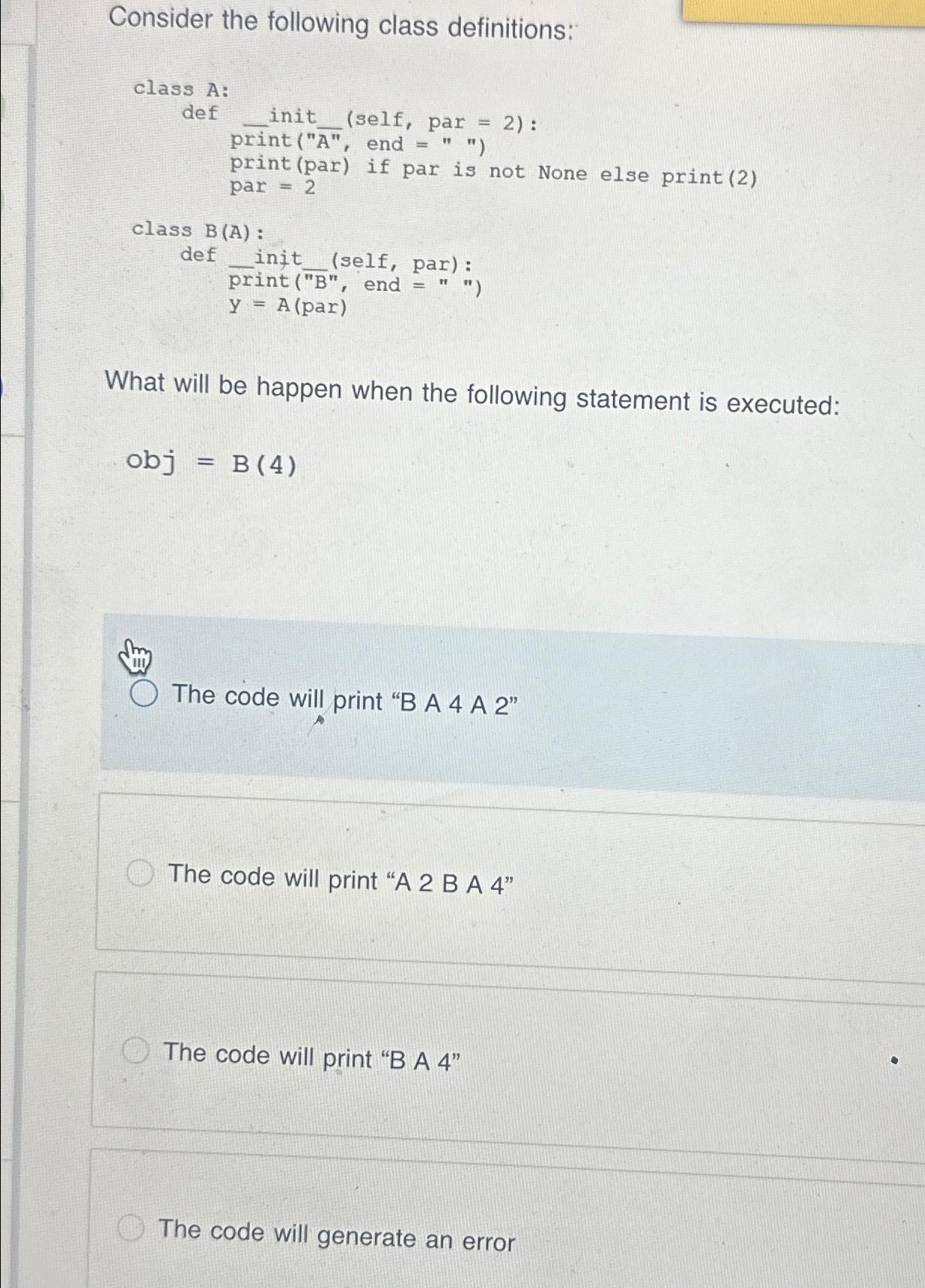
Consider the following class definitions: class A: def class B (A): init (self, par = 2) : print ("A", end = " ") print (par) if par is not None else print (2) par = 2 obj def init (self, par): print ("B", end = " ") y = A (par) What will be happen when the following statement is executed: = B (4) The code will print "B A 4 A 2" The code will print "A 2 B A 4" The code will print "B A 4" The code will generate an error
Step by Step Solution
3.37 Rating (141 Votes )
There are 3 Steps involved in it
The image presents a Python code snippet with two classes A and B where B is a subclass of A Here is ... View full answer

Get step-by-step solutions from verified subject matter experts
 Study Help