







Question: Consider the following classes: } public class A { } private int myNum; public A(int x) public int getNumber() public String getLetters() { return
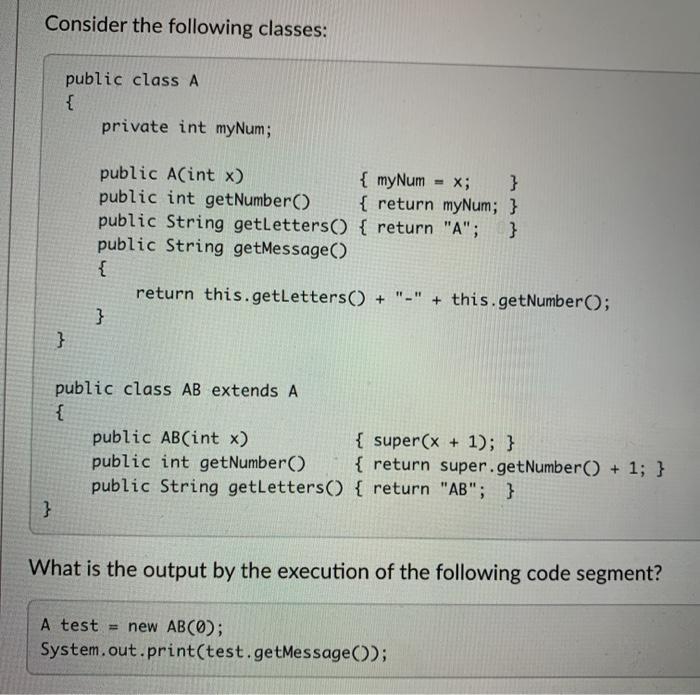
Consider the following classes: } public class A { } private int myNum; public A(int x) public int getNumber() public String getLetters() { return "A";} public String getMessage() { return this.getLetters() + "_" +this.getNumber(); } public class AB extends A { { myNum = X; } {return myNum; } public AB(int x) public int getNumber() public String getLetters() { return "AB"; } { super(x + 1); } { return super.getNumber() + 1; } What is the output by the execution of the following code segment? A test new AB(0); System.out.print(test.getMessage());
Step by Step Solution
There are 3 Steps involved in it
In the given code we have two classes A and AB AB is a subclass of A which means that AB inherits me... View full answer

Get step-by-step solutions from verified subject matter experts
 Study Help