







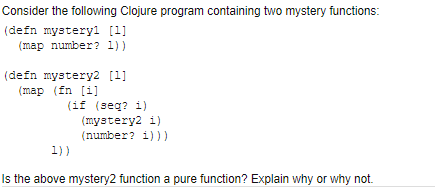
Question: Consider the following Clojure program containing two mystery functions: (defn mysteryi [1] (map number? 1)) (defn mystery2 (11 (map (in [i] (if (seq? 1) (mystery2
![[1] (map number? 1)) (defn mystery2 (11 (map (in [i] (if (seq?](https://dsd5zvtm8ll6.cloudfront.net/si.experts.images/questions/2024/09/66f4630e2289b_17366f4630dc03cc.jpg)


Consider the following Clojure program containing two mystery functions: (defn mysteryi [1] (map number? 1)) (defn mystery2 (11 (map (in [i] (if (seq? 1) (mystery2 i) (number? i))) 1)) Is the above mystery2 function a pure function? Explain why or why not. Any given programming language may be said to be strongly typed or weakly typed. In reality, they lie on a continuum between these two extremes. Where does C sit on this spectrum? Explain your answer. Any given language may be statically typed or dynamically typed. As above, the range of possibilities is really a continuum between these two extremes. Where does Clojure sit on this spectrum? Explain your answer. Explain the purpose of the Optional type
Step by Step Solution
There are 3 Steps involved in it

Get step-by-step solutions from verified subject matter experts
 Study Help