







Question: Consider the following data from two countries, called Green and Orange, from the Table below. Assume that individuals in both countries spend 50% of
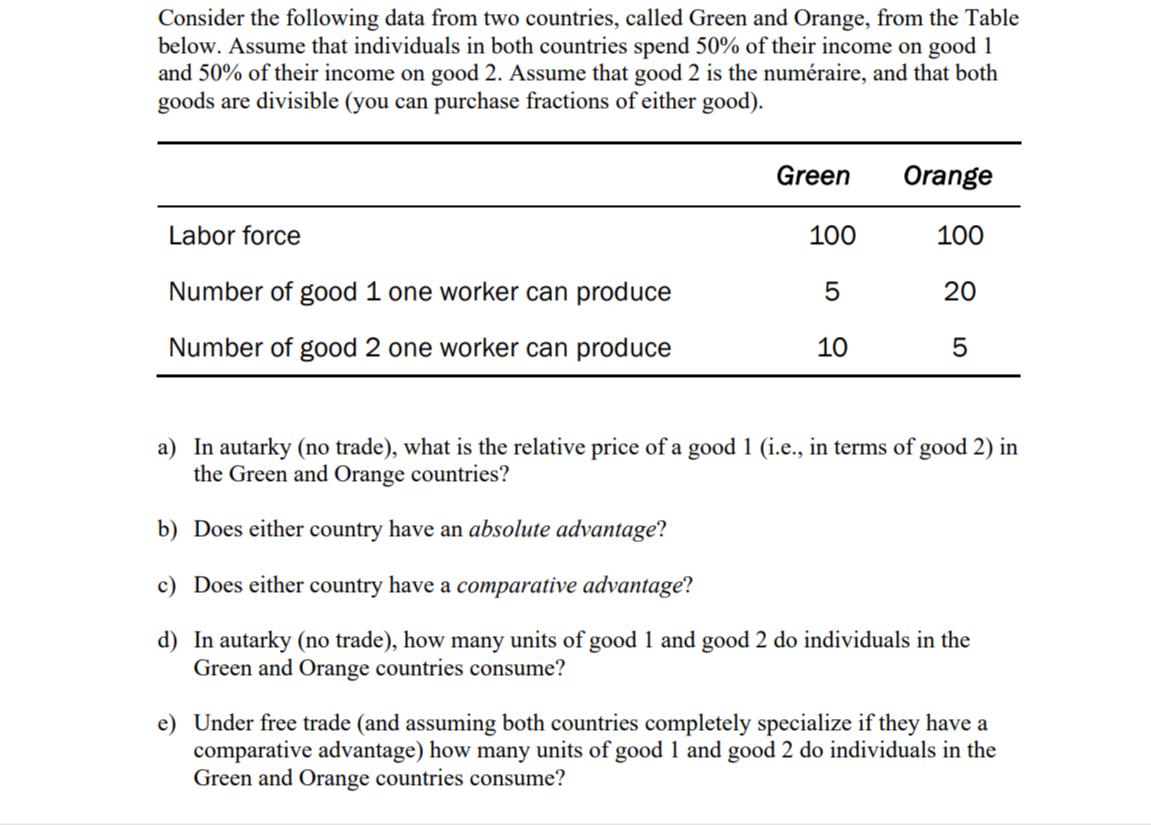
Consider the following data from two countries, called Green and Orange, from the Table below. Assume that individuals in both countries spend 50% of their income on good 1 and 50% of their income on good 2. Assume that good 2 is the numraire, and that both goods are divisible (you can purchase fractions of either good). Green Orange Labor force 100 100 Number of good 1 one worker can produce 5 20 Number of good 2 one worker can produce 10 5 a) In autarky (no trade), what is the relative price of a good 1 (i.e., in terms of good 2) in the Green and Orange countries? b) Does either country have an absolute advantage? c) Does either country have a comparative advantage? d) In autarky (no trade), how many units of good 1 and good 2 do individuals in the Green and Orange countries consume? e) Under free trade (and assuming both countries completely specialize if they have a comparative advantage) how many units of good 1 and good 2 do individuals in the Green and Orange countries consume?
Step by Step Solution
There are 3 Steps involved in it

Get step-by-step solutions from verified subject matter experts
 Study Help