



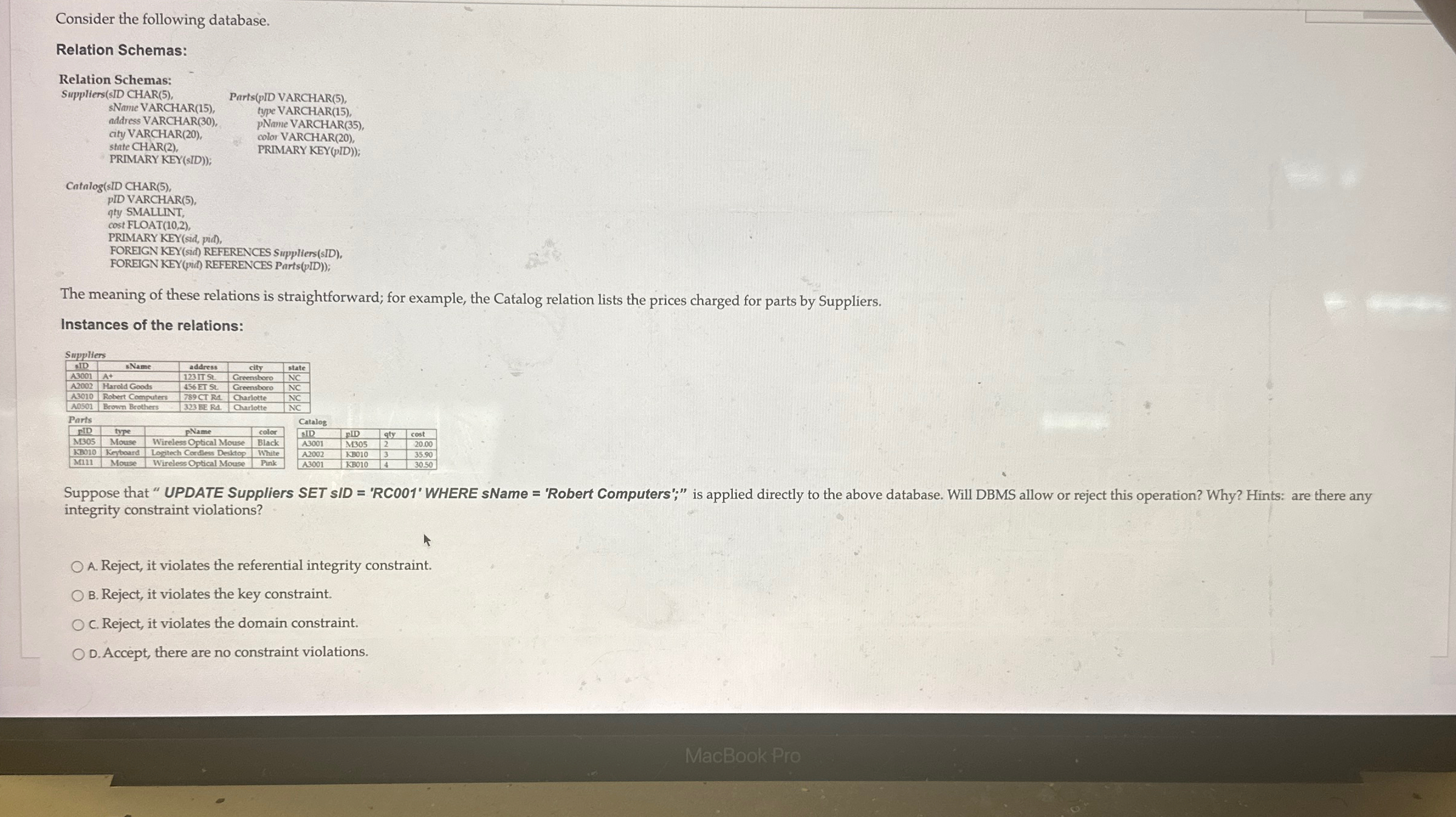
Question: Consider the following database. Relation Schemas: Relation Schemas: Suppliers ( SID CHAR ( 5 ) sName VARCHAR ( 1 5 ) , Parts ( pID
Consider the following database.
Relation Schemas:
Relation Schemas:
SuppliersSID CHAR
sName VARCHAR
PartspID VARCHAR
address VARCHAR
aity VARCHAR
type VARCHAR
state CHAR
pName VARCHAR
PRIMARY KEYsID:
PRIMARY KEYpID;
CatalogsID CHAR
pID VARCHAR
qty SMALLINT,
cost FLOAT
PRIMARY KEYsid pid
FOREIGN KEYsid REFERENCES SuppliersSID
FOREIGN KEYpid REFERENCES PartsD;
The meaning of these relations is straightforward; for example, the Catalog relation lists the prices charged for parts by Suppliers.
Instances of the relations:
Suppliers
tablesIDsName,address,city,stateAAt IT SLGreensboro,NCAHarold Goods,SET StGreensboro,NCARobert Computers, CT RdCharlotte,NCABrown Brothers, BE RdCharlotte,NC
Part
tableIDtype,PVame,colorMouse,Wireless Optical Mouse,BlackKBKeytroard,Logitech Cordless Desktor:,WhiteMouse,Wireless Optical Mouse,Pink
Catalog
tableSIDFID,gtycostAMAK BBAKB
integrity constraint violations?
A Reject, it violates the referential integrity constraint.
B Reject, it violates the key constraint.
C Reject, it violates the domain constraint.
D Accept, there are no constraint violations.
Step by Step Solution
There are 3 Steps involved in it
1 Expert Approved Answer
Step: 1 Unlock

Question Has Been Solved by an Expert!
Get step-by-step solutions from verified subject matter experts
Step: 2 Unlock
Step: 3 Unlock