







Question: Consider the following schema: SUPPLIERS (SID: integer, SNAME: string, STREET: string, CITY: string, ZIP: string) PARTS (PID:integer, PNAME: string, COLOR: string) CATALOG (SID: integer, PID:
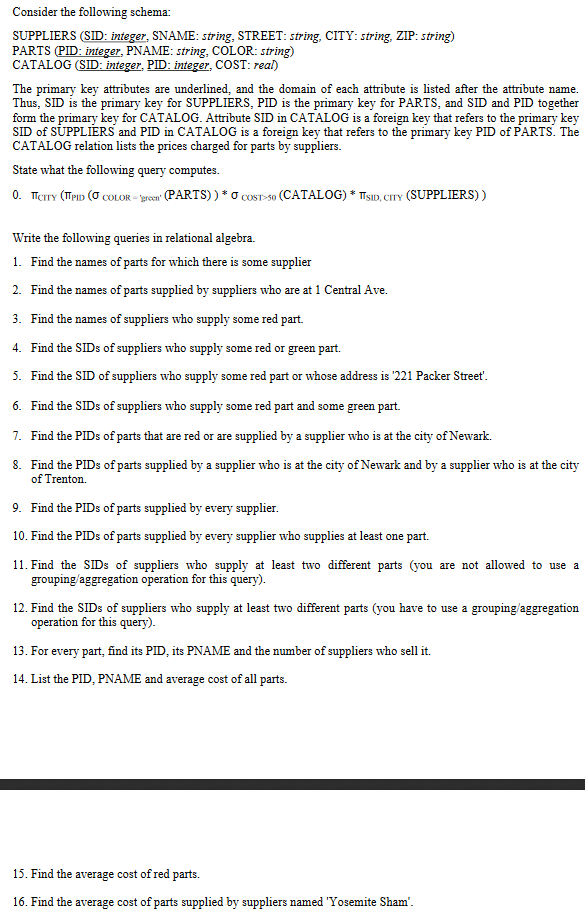
Consider the following schema: SUPPLIERS (SID: integer, SNAME: string, STREET: string, CITY: string, ZIP: string) PARTS (PID:integer, PNAME: string, COLOR: string) CATALOG (SID: integer, PID: integer, COST: real) The primary key attributes are underlined, and the domain of each attribute is listed after the attribute name. Thus, SID is the primary key for SUPPLIERS, PID is the primary key for PARTS, and SID and PID together form the primary key for CATALOG. Attribute SID in CATALOG is a foreign key that refers to the primary key SID of SUPPLIERS and PID in CATALOG is a foreign key that refers to the primary key PID of CATALOG relation lists the prices charged for parts by suppliers. PARTS. The State what the following query computes 0. TTCITY (TTPID ( coLOR-breen. (PARTS) ) * cosT>50 (CATALOG) * TsID, crrY (SUPPLIERS) ) Write the following queries in relational algebra. 1. Find the names of parts for which there is some supplier 2. Find the names of parts supplied by suppliers who are at 1 Central Ave. 3. Find the names of suppliers who supply some red part. 4. Find the SIDs of suppliers who supply some red or green part. 5. Find the SID of suppliers who supply some red part or whose address is '221 Packer Street' 6. Find the SIDs of suppliers who supply some red part and some green part. 7. Find the PIDs of parts that are red or are supplied by a supplier who is at the city of Newark. 8. Find the PIDs of parts supplied by a supplier who is at the city of Newark and by a supplier who is at the city of Trenton. 9. Find the PIDs of parts supplied by every supplier 10. Find the PIDs of parts supplied by every supplier who supplies at least one part. 11. Find the SIDs of suppliers who supply at least two different parts (you are not allowed to use a grouping aggregation operation for this query). 12. Find the SIDs of suppliers who supply at least two different parts (you have to use a grouping/aggregation operation for this query). 13. For every part, find its PID, its PNAME and the number of suppliers who sell it. 14. List the PID, PNAME and average cost of all parts. 15. Find the average cost of red parts. 16. Find the average cost of parts supplied by suppliers named 'Yosemite Sham Consider the following schema: SUPPLIERS (SID: integer, SNAME: string, STREET: string, CITY: string, ZIP: string) PARTS (PID:integer, PNAME: string, COLOR: string) CATALOG (SID: integer, PID: integer, COST: real) The primary key attributes are underlined, and the domain of each attribute is listed after the attribute name. Thus, SID is the primary key for SUPPLIERS, PID is the primary key for PARTS, and SID and PID together form the primary key for CATALOG. Attribute SID in CATALOG is a foreign key that refers to the primary key SID of SUPPLIERS and PID in CATALOG is a foreign key that refers to the primary key PID of CATALOG relation lists the prices charged for parts by suppliers. PARTS. The State what the following query computes 0. TTCITY (TTPID ( coLOR-breen. (PARTS) ) * cosT>50 (CATALOG) * TsID, crrY (SUPPLIERS) ) Write the following queries in relational algebra. 1. Find the names of parts for which there is some supplier 2. Find the names of parts supplied by suppliers who are at 1 Central Ave. 3. Find the names of suppliers who supply some red part. 4. Find the SIDs of suppliers who supply some red or green part. 5. Find the SID of suppliers who supply some red part or whose address is '221 Packer Street' 6. Find the SIDs of suppliers who supply some red part and some green part. 7. Find the PIDs of parts that are red or are supplied by a supplier who is at the city of Newark. 8. Find the PIDs of parts supplied by a supplier who is at the city of Newark and by a supplier who is at the city of Trenton. 9. Find the PIDs of parts supplied by every supplier 10. Find the PIDs of parts supplied by every supplier who supplies at least one part. 11. Find the SIDs of suppliers who supply at least two different parts (you are not allowed to use a grouping aggregation operation for this query). 12. Find the SIDs of suppliers who supply at least two different parts (you have to use a grouping/aggregation operation for this query). 13. For every part, find its PID, its PNAME and the number of suppliers who sell it. 14. List the PID, PNAME and average cost of all parts. 15. Find the average cost of red parts. 16. Find the average cost of parts supplied by suppliers named 'Yosemite Sham
Step by Step Solution
There are 3 Steps involved in it

Get step-by-step solutions from verified subject matter experts
 Study Help