







Question: Consider the following EBNF grammar for a very simple programming language S (statmnt) assnmt | ifstmt | do | inout | progcall ident exprsn; l
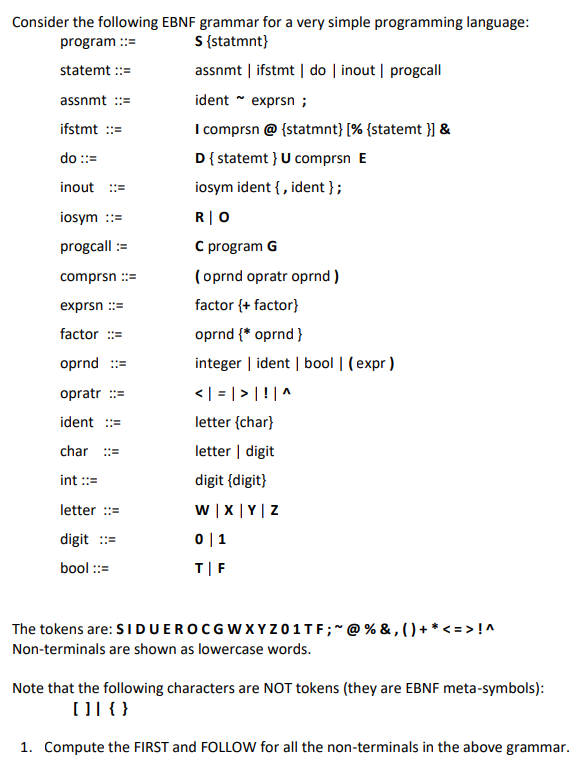
Consider the following EBNF grammar for a very simple programming language S (statmnt) assnmt | ifstmt | do | inout | progcall ident exprsn; l comprsn @ {statmnt} [% {statemt }] & D fstatemt U comprsn E iosym ident, ident\; program statemt- ifstmt do:- inout: osym- progcall:- comprsn exprsn- factor- oprnd- opratr- ident- char : int letter : digit bool: C program G (oprnd opratr oprnd) factor+ factorh oprnd oprnd ) integer | ident | bool | (expr) letter (char) letter | digit digit (digit) The tokens are: SI D U E ROCGWXYZO1TF.~@%&,()+"A Non-terminals are shown as lowercase words Note that the following characters are NOT tokens (they are EBNF meta-symbols) 1 ) 1. Compute the FIRST and FOLLOW for all the non-terminals in the above grammar Consider the following EBNF grammar for a very simple programming language S (statmnt) assnmt | ifstmt | do | inout | progcall ident exprsn; l comprsn @ {statmnt} [% {statemt }] & D fstatemt U comprsn E iosym ident, ident\; program statemt- ifstmt do:- inout: osym- progcall:- comprsn exprsn- factor- oprnd- opratr- ident- char : int letter : digit bool: C program G (oprnd opratr oprnd) factor+ factorh oprnd oprnd ) integer | ident | bool | (expr) letter (char) letter | digit digit (digit) The tokens are: SI D U E ROCGWXYZO1TF.~@%&,()+"A Non-terminals are shown as lowercase words Note that the following characters are NOT tokens (they are EBNF meta-symbols) 1 ) 1. Compute the FIRST and FOLLOW for all the non-terminals in the above grammar
Step by Step Solution
There are 3 Steps involved in it

Get step-by-step solutions from verified subject matter experts
 Study Help