



Question: Consider the following graph: 6 10 3 Draw how the graph would look if represented by an adjacency matrix. You may assume the indexes are
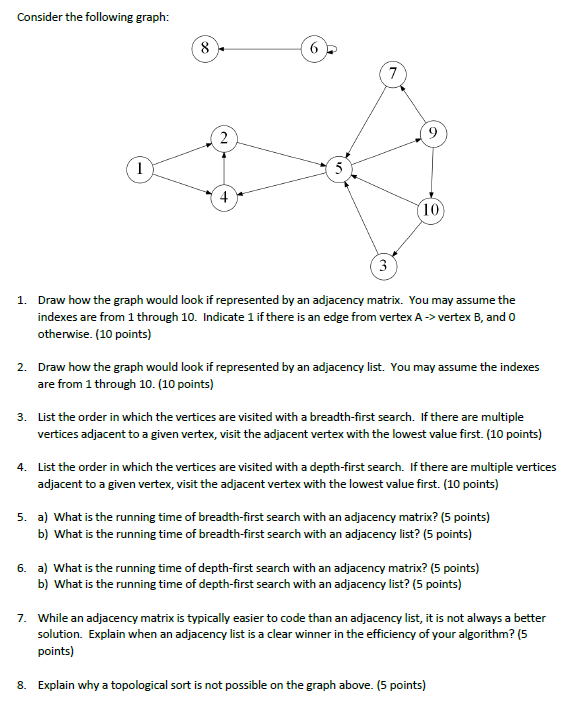
Consider the following graph: 6 10 3 Draw how the graph would look if represented by an adjacency matrix. You may assume the indexes are from 1 through 10. Indicate 1 if there is an edge from vertex A->vertex B, and 0 otherwise. (10 points) 1. Draw how the graph would look if represented by an adjacency list. You may assume the indexes are from 1 through 10. (10 points) 2. If there are multiple List the order in which the vertices are visited with a breadth-first search. vertices adjacent to a given vertex, visit the adjacent vertex with the lowest value first. (10 points) 3. List the order in which the vertices are visited with a depth-first search. If there are multiple vertices adjacent to a given vertex, visit the adjacent vertex with the lowest value first. (10 points) 4. 5. a) What is the running time of breadth-first search with an adjacency matrix? (5 points) b) What is the running time of breadth-first search with an adjacency list? (5 points) a) What is the running time of depth-first search with an adjacency matrix? (5 points) b) What is the running time of depth-first search with an adjacency list?(5 points) 6. 7. While an adjacency matrix is typically easier to code than an adjacency list, it is not always a better solution. Explain when an adjacency list is a clear winner in the efficiency of your algorithm? (5 points)
Step by Step Solution
There are 3 Steps involved in it

Get step-by-step solutions from verified subject matter experts